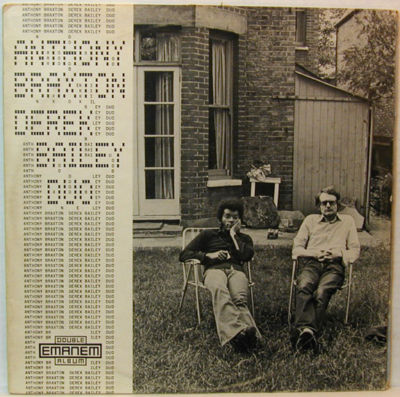
Anthony Braxton Derek Bailey Duo 2LP Emanem UK 1974
$
41


Favourite Auctions
To save auctions to your favourites, please login
If you don't have an account, please register
Description
Anthony Braxton Derek Bailey Duo 2LP Emanem UK
Emanem 601, original 2 LP 1974 pressing – not a reissue
VG+ gatefold cover w light wear / EX / EX vinyl
Genius is a rare commodity in any art form, but at the end of the 20th century it seemed all but non-existent in jazz, a music that had ceased looking ahead and begun swallowing its tail. If it seemed like the music had run out of ideas, it might be because Anthony Braxton covered just about every conceivable area of creativity during the course of his extraordinary career. The multi-reedist/composer might very well be jazz's last bona fide genius. Braxton began with jazz's essential rhythmic and textural elements, combining them with all manner of experimental compositional techniques, from graphic and non-specific notation to serialism and multimedia. Even at the peak of his renown in the mid- to late '70s, Braxton was a controversial figure amongst musicians and critics. His self-invented (yet heavily theoretical) approach to playing and composing jazz seemed to have as much in common with late 20th century classical music as it did jazz, and therefore alienated those who considered jazz at a full remove from European idioms. Although Braxton exhibited a genuine -- if highly idiosyncratic -- ability to play older forms (influenced especially by saxophonists Warne Marsh, John Coltrane, Paul Desmond, and Eric Dolphy), he was never really accepted by the jazz establishment, due to his manifest infatuation with the practices of such non-jazz artists as John Cage and Karlheinz Stockhausen. Many of the mainstream's most popular musicians (Wynton Marsalis among them) insisted that Braxton's music was not jazz at all. Whatever one calls it, however, there is no questioning the originality of his vision; Anthony Braxton created music of enormous sophistication and passion that was unlike anything else that had come before it. Braxton was able to fuse jazz's visceral components with contemporary classical music's formal and harmonic methods in an utterly unselfconscious -- and therefore convincing -- way. The best of his work is on a level with any art music of the late 20th century, jazz or classical.
Braxton began playing music as a teenager in Chicago, developing an early interest in both jazz and classical musics. He attended the Chicago School of Music from 1959-1963, then Roosevelt University, where he studied philosophy and composition. During this time, he became acquainted with many of his future collaborators, including saxophonists Joseph Jarman and Roscoe Mitchell. Braxton entered the service and played saxophone in an Army band; for a time he was stationed in Korea. Upon his discharge in 1966, he returned to Chicago where he joined the nascent Association for the Advancement of Creative Musicians (AACM). The next year, he formed an influential free jazz trio, the Creative Construction Company, with violinist Leroy Jenkins and trumpeter Leo Smith. In 1968, he recorded For Alto, the first-ever recording for solo saxophone. Braxton lived in Paris for a short while beginning in 1969, where he played with a rhythm section comprised of bassist Dave Holland, pianist Chick Corea, and drummer Barry Altschul. Called Circle, the group stayed together for about a year before disbanding (Holland and Altschul would continue to play in Braxton-led groups for the next several years). Braxton moved to New York in 1970. The '70s saw his star rise (in a manner of speaking); he recorded a number of ambitious albums for the major label Arista and performing in various contexts. Braxton maintained a quartet with Altschul, Holland, and a brass player (either trumpeter Kenny Wheeler or trombonist George Lewis) for most of the '70s. During the decade, he also performed with the Italian free improvisation group Musica Elettronica Viva, and guitarist Derek Bailey, as well as his colleagues in AACM. The '80s saw Braxton lose his major-label deal, yet he continued to record and issue albums on independent labels at a dizzying pace. He recorded a memorable series of duets with bop pioneer Max Roach, and made records of standards with pianists Tete Montoliu and Hank Jones. Braxton's steadiest vehicle in the '80s and '90s -- and what is often considered his best group -- was his quartet with pianist Marilyn Crispell, bassist Mark Dresser, and drummer Gerry Hemingway. In 1985, he began teaching at Mills College in California; he subsequently joined the music faculty at Wesleyan College in Connecticut, where he taught through the '90s. During that decade, he received a large grant from the MacArthur Foundation that allowed him to finance some large-scale projects he'd long envisioned, including an opera. At the beginning of the 21st century, Braxton was still a vital presence on the creative music scene.
At first glance, Derek Bailey possesses almost none of the qualities one expects from a jazz musician -- his music does not swing in any appreciable way, it lacks a discernible sense of blues feeling -- yet there's a strong connection between his amelodic, arhythmic, atonal, uncategorizable, free-improvisatory style, and much free jazz of the post-Coltrane era. His music draws upon a vast array of resources, including indeterminany, rock & roll, and various world musics. Indeed, this catholic acceptance of any and all musical influences is arguably what sets Bailey's art outside the strict bounds of "jazz." The essential element of his work, however, is the type of spontaneous musical interrelation that evolved from the '60s jazz avant-garde. Sound, not ideology, is Bailey's medium. He differs in approach to almost any other guitarist who preceded him. Bailey uses the guitar as a sound-making, rather than a "music"-making, device, meaning, he rarely plays melodies or harmonies in a conventional sense, but instead pulls out of his instrument every conceivable type of sound using every imaginable technique. His timbral range is quite broad. On electric guitar, Bailey is capable of the most gratingly harsh, distortion-laden heavy-metalisms; unamplified, he's as likely to mimic a set of wind chimes. Bailey's guitar is much like John Cage's prepared piano; both innovations enhanced the respective instrument's percussive possibilities. As a group player, Bailey is an exquisitely sensitive respondent to what goes on around him. He has the sort of quick reflexes and complementary character that can meld random musical events into a unified whole.
Bailey came from a musical family; his grandfather and uncle were musicians. As a youngster living in Sheffield in the '40s, Bailey studied music with C.H.C. Biltcliffe and guitar with George Wing and John Duarte. Bailey began playing conventional jazz and commercial music professionally in the '50s. In the early '60s, Bailey played in a trio called Joseph Holbrooke, with drummer Tony Oxley and bassist (and later renowned classical composer) Gavin Bryars. In the course of its existence, from 1963-1966, the group evolved from playing relatively traditional jazz with tempo and chord changes, to playing totally free. In 1966, Bailey moved to London; there, he formed a number of important musical associations with, among others, drummer John Stevens, saxophonist Evan Parker, trumpeter Kenny Wheeler, and bassist Dave Holland. This specific collection of players recorded as the Spontaneous Music Ensemble, which served as a crucible for the sort of egalitarian, collective improvisation that Bailey was to pursue from then on. In 1968, Bailey joined Oxley -- another musician interested in new possibilities of sound generation -- in whose sextet he remained until 1973. In 1970, Bailey formed the trio Iskra with bassist Barry Guy and trombonist Paul Rutherford. Also that year, Bailey started (with Parker and Oxley) the Incus record label, for which he would continue to record into the '90s. In 1976, Bailey founded Company, a long-lived free improv ensemble with ever-shifting personnel, which has included, at various times, Anthony Braxton, Han Bennink, Steve Lacy, and George Lewis, among others.
Originally issued as a double album on Emanem and the results of a concert given June 30, 1974 in London (the rehearsal extract was recorded the preceding day). The music here went to the furthest borders where the line between sound and music became most abstract.
– All Music Guide
Check my other auctions this week for more original jazz, rock and avant LPs.
Please read: items are visually graded.
Shipping: $4 Media Mail/US
$7 Priority Mail/US
$9.50/Canada
$15/All other countries
Additional LPs, add $1 per record US, $2 per record other countries. You will be invoiced at the end of the auction.
Method of payment: Paypal only
price rating