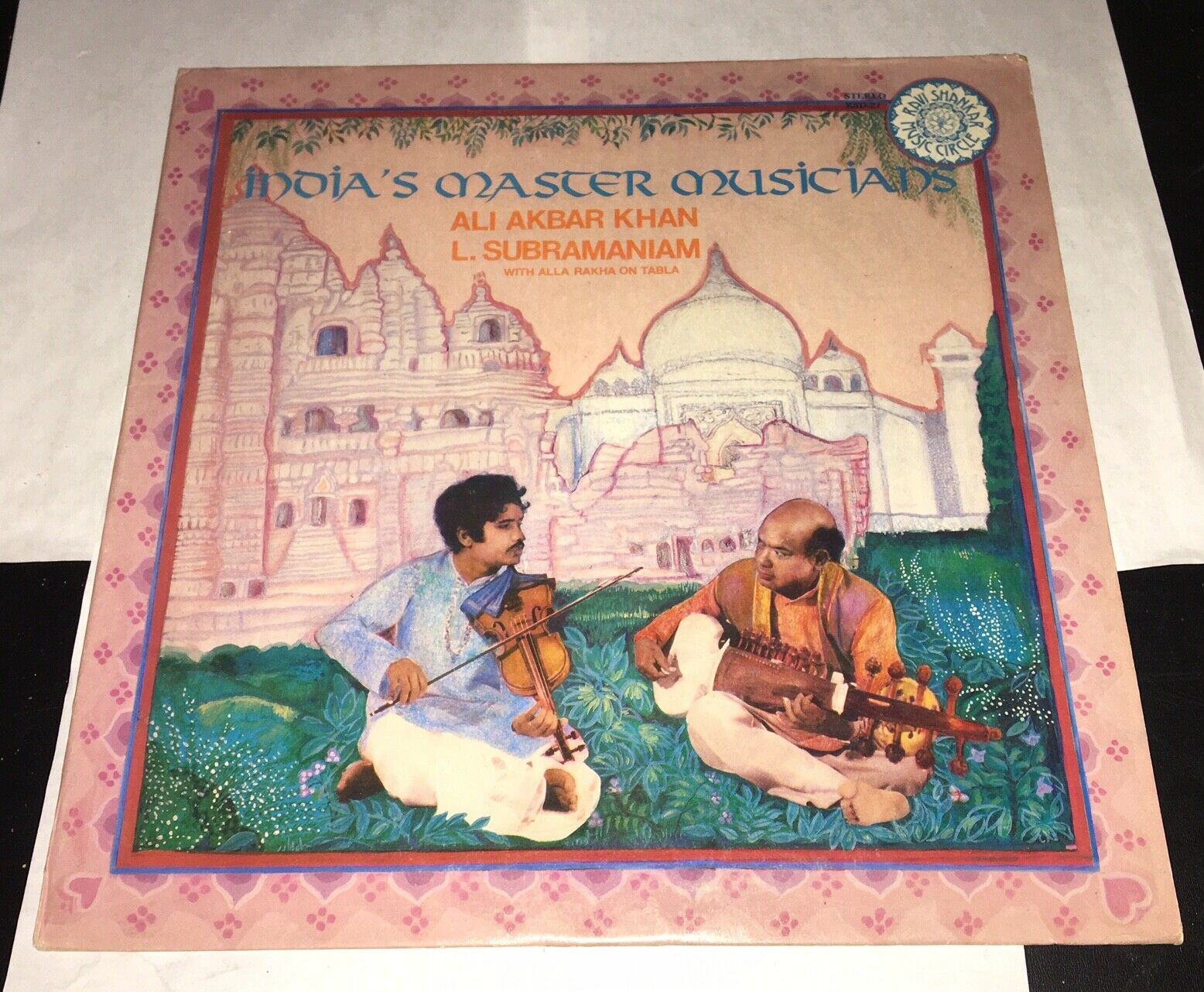
Ali Akbar Khan & L. Subramaniam ?India's Master Musicians 1981 Rare Hindustani
$
25


Favourite Auctions
To save auctions to your favourites, please login
If you don't have an account, please register
Description
Ali Akbar Khan & L. Subramaniam ?– India's Master Musicians Label: Bainbridge Records ?– RSD -27 Format: Vinyl, LP, Stereo Country: US Released: 1981 Genre: Folk, World, & Country Style: Indian Classical, Hindustani Tracklist A Sindhi Bhairavi B Sindhi Bhairavi (Part 2) Credits Sarod – Ali Akbar Khan Tabla – Zakir Hussain Violin – L. Subramaniam
Ali Akbar Khan (14 April 1922 – 18 June 2009) was a Hindustani classical musician of the Maihar gharana, known for his virtuosity in playing the sarod. Trained as a classical musician and instrumentalist by his father, Allauddin Khan, he also composed several classical ragas and film scores.[1] He established a music school in Calcutta in 1956, and the Ali Akbar College of Music in 1967, which moved with him to the United States and is now based in San Rafael, California, with a branch in Basel, Switzerland.
Khan was instrumental in popularizing Indian classical music in the West, both as a performer and as a teacher. He first came to America in 1955 on the invitation of violinist Yehudi Menuhin and later settled in California.[2] He was a Distinguished Adjunct Professor of Music at the University of California, Santa Cruz.[3]
Khan was accorded India's second highest civilian honour, the Padma Vibhushan, in 1989.[4] Nominated five times for the Grammy Award, Khan was a recipient of the MacArthur Fellowship and the National Endowment for the Arts's National Heritage Fellowship.
Ali Akbar Khan was born in the village of Shibpur, Nabinagar Upazila, Brahmanbaria, in present-day Bangladesh, (then Comilla, East Bengal), to renowned musician and teacher, Allauddin Khan and Madina Begum.[5] Soon after his birth, Khan's family returned to Maihar (in present-day Madhya Pradesh, India) where his father was the primary court musician for the Maharaja of the princely state.
From an early age Khan received training from his father in various instruments as well as vocal composition, but finally gravitated towards the sarod. Allauddin was a perfectionist and a strict taskmaster, and Khan's lessons started before dawn and often lasted 18 hours a day.[7] Khan also learned to play the tabla and the pakhavaj from his uncle, Aftabuddin Khan, who he visited at Shibpur.[8] During this period he met several prominent musicians, such as the sarodist Timir Baran and flautist Pannalal Ghosh, who came to study with his father; in later years he was joined in his lessons by his sister Annapurna Devi, who became an accomplished player of the surbahar, and fellow student Ravi Shankar. Shankar and Annapurna Devi were married in 1941.
Of his training on the sarod, he wrote:
If you practice for ten years, you may begin to please yourself, after 20 years you may become a performer and please the audience, after 30 years you may please even your guru, but you must practice for many more years before you finally become a true artist—then you may please even God.[9]
Career
Khan on a 2014 stamp sheet of India Ali Akbar Khan, after years of rigorous training, gave his debut performance at a music conference in Allahabad in 1936, at the age of 13. Three years later, in December 1939, he accompanied Ravi Shankar on the sarod during the latter's debut performance at the same conference; this was the first of many jugalbandis (duets) between the two musicians. In 1938 Khan gave his first recital on All India Radio (AIR), Bombay (accompanied on the tabla by Alla Rakha), and starting in January 1940, he gave monthly performances on AIR, Lucknow. Finally in 1944, both Shankar and Khan left Maihar to start their professional careers as musicians; Shankar went to Bombay, while Khan became the youngest Music Director for AIR, Lucknow, and was responsible for solo performances and composing for the radio orchestra.[7]
In 1943, on his father's recommendation, Khan was appointed a court musician for the Maharaja of Jodhpur, Hanwant Singh.[10] There, he taught and composed music besides giving recitals and was accorded the title of Ustad by the Maharaja. When the princely states were wound down with India's independence in 1947 and Hanwant Singh died in a plane crash in 1948, Khan moved to Bombay.[7]
In Bombay, he won acclaim as a composer of several film scores, including Chetan Anand's Aandhiyan (1952). Lata Mangeshkar sang the title song, "Har Kahin Pe Shaadmani" and as a token of her respect to sarod maestro, did not charge any fee.[11] This was followed by Satyajit Ray's Devi (1960), Merchant-Ivory's The Householder, and Tapan Sinha's Khudito Pashan ("Hungry Stones", 1960), for which he won the "Best Musician of the Year" award. He also played Sarod for a song in 1955 film Seema which had the music composed by Shankar Jaikishan. Later in 1993, he would score some of the music for Bernardo Bertolucci's Little Buddha.[12]
Beginning in 1945, Khan also started recording a series of 78 rpm disks (which could record about three minutes of music) at the HMV Studios in Bombay. For one such record he conceived a new composition Raga Chandranandan ("moonstruck"), based on four evening ragas, Malkauns, Chandrakauns, Nandakauns and Kaushi Kanada. This record was a huge success in India, and the raga found a worldwide audience when a 22-minute rendition was re-recorded for the Master Musician of India LP in 1965 ? one of Khan's seminal recordings.[13]
He performed in India and traveled extensively in the West. In 1956, Khan founded the Ali Akbar College of Music in Calcutta, with the mission to teach and spread Indian classical music. He founded another school of the same name in Berkeley, California in 1967 and later moved it to San Rafael, California.[10] Khan performed in Boston with Shankar Ghosh in 1969 for the Peabody Mason Concert series. In 1985 he founded another branch of the Ali Akbar College of Music in Basel, Switzerland. Khan was the first Indian musician to record an LP album of Indian classical music in the United States and to play sarod on American television.[14]
Khan has participated in a number of classic jugalbandi pairings, most notably with Ravi Shankar, Nikhil Banerjee and violinist L. Subramaniam. A few recordings of duets with Vilayat Khan also exist. He also collaborated with Western musicians. In August 1971, Khan performed at Madison Square Garden for the Concert for Bangladesh, along with Ravi Shankar, Alla Rakha and Kamala Chakravarty; other musicians at the concert included George Harrison, Bob Dylan, Eric Clapton and Ringo Starr. A live album and a movie of the event were later released.[1][10]
Illness and death Khan was based in the United States for the last four decades of his life. He toured extensively until he was prevented from doing so by ill health. He had been a dialysis patient since 2004. He died from kidney failure at his home in San Anselmo, California.[15]
Personal life Ali Akbar Khan married three times (first Zubeida Begum, then Rajdulari Khan Sahiba, and last one Mary Khan), and is survived by eight sons and four daughters. Six of his children and one grandson are musicians: Aashish Khan Debasharma (b 1939, sarod), Dhyanesh Khan (1941–90; sarod), Ameena Perrera (Sitar), Pranesh Khan (tabla), Rajesh Khan (sarod), Alam Khan (b 1982, sarod), Manik Khan (Sarod); and his grandson, Shiraz Ali Khan (sarod).
Awards Khan was awarded the Padma Bhushan in 1967[16] and the Padma Vibhushan in 1989,[17] among other awards. He received a MacArthur Fellowship in 1991,[10] the first Indian musician to receive the so-called "genius grant".[15] In 1997, Khan received the National Endowment for the Arts' prestigious National Heritage Fellowship, the United States' highest honour in the traditional arts.[18] Khan received five Grammy nominations over the course of his life.
Pandit Dr. Lakshminarayana Subramaniam (born 23 July 1947) is an acclaimed Indian violinist, composer and conductor, trained in the classical Carnatic music tradition and Western classical music, and renowned for his virtuoso playing techniques and compositions in orchestral fusion.
Performance with his son Ambi Subramaniam at Bharat Bhavan Bhopal
Subramaniam was born to V. Lakshminarayana Iyer and Seethalakshmi, both accomplished musicians.[1]
He lived in Jaffna during his younger years, taking up music studies before the age of five.[2] He began training in violin under the tutelage of his father, Professor V. Lakshminarayana. "Mani", as he is fondly known by fellow musicians and his family, gave his first public performance at the age of six.
His uncles include Ramnad Raghavan and Ramnad Krishnan.[3] His brothers are also acclaimed musicians, and include the violinist-composers L. Shankar (alias. Shenkar), and the late L. Vaidyanathan.[4] He has released recordings with both.
Subramaniam developed a passion for music as well as science from a young age, studying Medicine and acquiring his M.B.B.S. at Madras Medical College. He registered as a General Practitioner, before deciding to pursue music full-time.[2] He has a Master's degree in Western classical music, which he acquired at the California Institute of the Arts.[2]
Performing career
Yehudi Menuhin, Stephane Grappelli and L. Subramaniam Since 1973, Subramaniam has amassed over 200 recordings to his credit, releasing several solo albums, recording collaborations with musicians Yehudi Menuhin, Stéphane Grappelli, Ruggiero Ricci and Jean-Pierre Rampal, further to making albums and performing with Ruggiero Ricci, Herbie Hancock, Joe Sample, Jean-Luc Ponty, Stanley Clarke John Handy, George Harrison[5] and several others.[6]
He has accompanied highly regarded vocalists in Carnatic music on stage including Chembai Vaidyanatha Bhagavatar, K. V. Narayaswamy, Dr. Sripada Pinakapani, Semmangudi Srinivasa Iyer, M. Balamuralikrishna and M. D. Ramanathan. He has also performed many concerts with the venerable Palghat Mani Iyer on the Mridangam, in addition to collaborating with musicians of North Indian Hindustani music and artists of other music systems.[6]
Subramaniam has written works for orchestras, ballets and Hollywood film scores, and written books on music – such as Euphony – in addition to composing symphonies and Carnatic pieces.[6][7]
In 1983, he composed a Double Concerto for violin and flute which combined western scales with micro intervals. Another release, Spring – Rhapsody, was a homage to Bach and Baroque music. Creations with orchestras that have followed include Fantasy on Vedic Chants with the New York Philharmonic, conducted by Zubin Mehta, Turbulence with The Swiss Romande Orchestra, "The Concert of Two Violins" with the Oslo Philharmonic, and Global Symphony with the Berlin State Opera (broadcast live to 28 nations) among others.[7] He has also performed a concert tour of China, with the Beijing Symphony Orchestra in Beijing.
His compositions have been used in stage presentations of leading dance companies such as the San Jose Ballet company and the Alvin Ailey American Dance Theater. Subramaniam composed the piece "Shanti Priya" for the Mariinsky Ballet.
The release of his albums, including Global Fusion in 1999 have brought Subramaniam widespread critical acclaim, and popularity for his advanced playing. He founded and directs the Lakshminarayana Global Music Festival, a festival based in India. In 2004, he completed a world tour with the festival, including concerts in the US (Lincoln Center, New York), the Asian Pacific region including in Perth, Australia, at the Esplanade, Singapore, the Sri Dewan Penang Hall in Penang and the Putra World Trade Centre in Kuala Lumpur, Malaysia. Performing with Subramaniam at the festival in January 2005 were violin maestro Arve Tellefsen, the Oslo Camerata, jazz legends Stanley Clarke, George Duke, Al Jarreau, Earl Klugh and Ravi Coltrane.
In September 2007, Subramaniam premiered and played "The Freedom Symphony" with the Fairfax Symphony Orchestra, Warrenton Chorale and Carnatic percussionists, which led to a strongly favourable ovation and an encore piece "Flight of the Humble Bee". Subramaniam is on the advisory board of composer A. R. Rahman's KM Music Conservatory in Kodambakkam, Chennai.
In 2011, he was invited to perform at the United Nations. On 24 October 2012, he performed as a Special Guest Artist with Stevie Wonder at the latter's message of peace concert at the UN. Yehudi Menuhin said of Subramaniam:
“ I find nothing more inspiring than the music making of my very great colleague Subramaniam. Each time I listen to him, I am carried away in wonderment."[6] ” When asked about his musical accomplishments, Subramaniam has always said,
“ Music is a vast ocean and no one can claim to know it all. The more you know, the more you realise how little you know. It is an eternal quest. ” Film career He composed the film scores for the films Salaam Bombay (1988) and Mississippi Masala (1991) directed by Mira Nair, in addition to being the featured violin soloist in Bernardo Bertolucci's Little Buddha (1993) and Cotton Mary (1999) of Merchant-Ivory productions.[6]
Awards and recognition PhD in Music (Thesis on Raga Harmony for Orchestral compositions), Jain University (2017) D. Litt. Honoris Causa of ITM University, Gwalior (M.P.) (2016) Lifetime Achievement Award, Limca Book of Records (2012) GiMA (Best Carnatic Instrumental Album – Innovations), Global Indian Music Academy (2012) Uttam Vag Geykar Jialal Vasant Award, Ajivasan (2011) Big Star IMA Award (Best Classical Instrumental Album – Violin Maestros), Indian Music Academy (2011) GiMA (Best Carnatic Instrumental Album – Violin Maestros), Global Indian Music Academy (2010) GiMA (Best Fusion Album – Live at Neues Gewandhaus, Leipzig), Global Indian Music Academy (2010) Tantri Nada Mani, Kanchi Kamakoti Peetham, Kanchipuram (2009) Asthana Vidwan, ISKCON, Bangalore (2009) Viswa Kala Bharathi Bharat Kalachar, Chennai (2004) Sangeetha Kalaratna, Bangalore Gayana Samaja (2004) Sangeetha Kalaa Shiromani, Percussive Arts Centre, Bangalore (2004) Honorary Doctorate, Bangalore University (2003) Padma Bhushan, Government of India(2001)[8] Manaviyam (Millennium) Award, Government of Kerala (2001) Lotus Festival Award, City of Los Angeles (1998) Special Medal of Honour, HH King Birendra of Nepal (1997) Best Composer Award/Commission, NRK P2, Norway (1996) Sangeeta Ratna Mysore, T. Chowdaiah Memorial National Award (1996) Awarder at the World Music Festival at Madison Square Gardens, Bharatiya Vidya Bhavan, New York (1995) Nada Chakravarthy, Ganapathi Sachchidananda Swamiji, Trinidad (1993) Onida Pinnacle Award (Best title track composer: Surabhi) (1993) Creative Music Award, Sangeet Natak Akademi (1990) Padma Shri, Government of India (1988) Award for outstanding contribution to Indo-American goodwill, understanding and friendship, Indo-American Society (1988) Sangeeta Sagaram, Cultural Centre of Performing Arts (1984) Grammy Nomination (for the album Indian Classical Music) (1981) Orpheus of the East Kala Samarpana, Alliance Francaise, Chennai (24 November 1972) Violin Chakravarthy, Governor of Madras (6/11/1972) Best Western Instrumentalist, IIT Madras (1972) President's Award for Best Violinist, All India Radio (1963)[9] Personal life Subramaniam was married to Viji (Vijayashree Shankar) Subramaniam, who died on 9 February 1995 and since November 1999 has been married to the Indian playback singer Kavita Krishnamurthy. He has four children with Viji — Gingger Shankar, Bindu Subramaniam, Dr. Narayana Subramaniam, and Ambi Subramaniam.
He continues to perform pieces with his daughter singer/songwriter Bindu Subramaniam,[10] violin duets with his son, Ambi Subramaniam,[11]” and has further recorded and given several concerts with Krishnamurthy. Their collaborations have earned them the nickname Subramaniam Gharana.[12] He also performs with his eldest son Dr. Narayana Subramaniam.[13]
Lakshminarayana Global Music Festival He started the Lakshminarayana Global Music Festival in 1992, to honour the memory of his father Professor V. Lakshminarayana, who died in 1990.[5] Artists have included the Subramaniam family, Al Jarreau, George Duke, Solo Cissokho, Miya Masaoka, Mark O'Connor, Loyko, Jean-Luc Ponty, Ustad Bismillah Khan, Larry Coryell, Arve Tellefsen, Pandit Jasraj, Dr. M. Balamuralikrishna, Corky Siegel.[14][15]
The festival has centred around special concepts such as Violins for Peace, Visions of India and Sounds of India.[14]
price rating