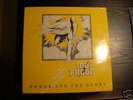
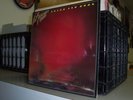
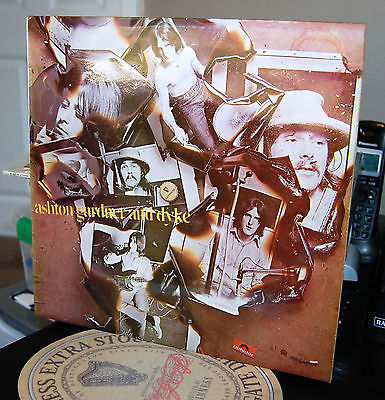
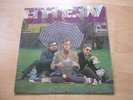
ASHTON, GARDNER & DYKE. " ASHTON GARDNER AND DYKE " POLYDOR UK 1969 LP. EX
£
20
$
27


Favourite Auctions
To save auctions to your favourites, please login
If you don't have an account, please register
Description
Ashton, Gardner & Dyke ?– Ashton, Gardner And Dyke
Label: Polydor ?– 583 081 Format: Vinyl, LP, AlbumCountry: UK Released: 1969 Genre: Rock Style: Classic Rock
Tracklist
A1 Rolling Home A2 Why Did You Go A3 The Falling Song A4 Young Man A5 Billy And His Piano Without A6 Maiden Voyage B1 New York Mining Desaster 1941 B2 Picture Sliding Down The Wall B2 Billy And His Piano With B2 Vaggsang B5 As It Was In The First PlaceNotes
Their first album. UK first pressAllMusic Review by Dave Thompson [-]
The debut album by one of Britain's lesser-starred supergroup is a markedly different beast than fans of their former bands, the Remo Four and Creation, might have expected. Heavily influenced by the trio's shared love for jazz-rock, its nine songs are moods as much as music, only occasionally stepping out into something instantly recognizable -- distinctive covers of the Bee Gees' "New York Mining Disaster 1941" and Mose Allison's "Young Man Blues" are highlights. But the album peaks with its closing track, "As It Was in the First Place" a lengthy Ashton adaptation from the classical "Adagio from Concierto de Aranjuez." With an arrangement borrowed from the Modern Jazz Quartet's own interpretation of the piece (among Tony Ashton's idols, few were more significant than MJQ's John Lewis), Ashton andRoy Dyke had already had one stab at the track, recording it with producer George Harrison during the last days of the Remo Four. The new version completely rewired that earlier performance, and stands as one of the pinnacles of British jazz-rock. The single "Maiden Voyage" offers another, while the group's sense of humor is well-evidenced by the similarly titled and themed pieces "Billy and his Piano Without" and "Billy and His Piano With."
Artist Biography by Dave Thompson
Launching in 1968 from the wreckage of the Remo 4, keyboard player Tony Ashton and drummer Roy Dyke linked with former Birds and Creation bassist Kim Gardner when those bands split to formAshton, Gardner & Dyke in emulation of the Nice's then-revolutionary keyboards and rhythm lineup. Signing with Polydor, Ashton, Gardner & Dyke debuted with the aptly named single "Maiden Voyage," swiftly following through with an eponymous album -- highlights of the set included an absolute reworking of "In the First Place," now titled "As It Was in the First Place." The album did little, however, even after the band toured with Delaney & Bonnie, and by 1970 the band signed to Capitol.
That same year, Ashton was among the many musicians appearing on George Harrison's latest solo album, the triple-disc All Things Must Pass, contributing keyboards to "Isn't It a Pity." For whatever reason, he wasn't credited on the album, but Harrison repaid him generously, teaming up with Eric Clapton to join Ashton, Gardner & Dyke as they set to work on their sophomore album. Jim Price and Bobby Keys, fellow stars of the Delaney & Bonnie outing, were already aboard; under the not especially mysterious pseudonyms ofGeorge O'Hara Smith and Sir Cedric Clayton, Harrison andClapton appear on the track "I'm Your Spiritual Breadman." Originally scheduled to be the band's next single, the song was ultimately passed over in favor of "Resurrection Shuffle" ("Breadman" was relegated to the American B-side), a smart move that resulted in a worldwide hit. A gritty, horn-laden R&B shouter, "Resurrection Shuffle" went to number three in the U.K. in January 1971, followed by a Top 40 berth in the U.S., and even landed a punchy cover version by Tom Jones. An album, titled after the hit, followed and, though it climbed no higher than number 185, it remains a period favorite, both among students of early-'70s rock and withHarrison and Clapton fans. British pressings of the album, incidentally, were retitled The Worst of Ashton, Gardner & Dyke, a wryly self-effacing name that might explain its chart failure. In the wake of the hit, the trio embarked on a period of solid gigging -- one excellent show from this period is captured on the posthumous Let It Roll Live album. Unfortunately, although "Resurrection Shuffle" raised the trio's profile immeasurably, it also crippled the group completely. Audiences wanted more of the same; the band wanted to push ahead. "The hit backfired on us," Ashton mourned years later. "We wanted to be an album band, but once you've got a big hit, you're in the pop league." It was early 1973 before the trio finally released a follow-up single, "Can You Get It," and few observers -- themselves included -- were surprised that it did little. A similar fate awaited the band's third album, What a Bloody Long Day It's Been, and by mid-1973 the band had broken up. Ashton and Dyke immediately reconvened the Remo 4 for a one-off reunion, cutting a new album, Attention, for release in Germany. (A second reunion occurred in 1997.) Dyke then formed Badger with Yes founder Tony Kaye, cutting one album before recruiting both Gardner and another artist with strong Harrison connections, former Apple star Jackie Lomax. When Badger split, Dyke moved into session work with the likes of Chris Barber, Café Society, and Pat Travers, before moving to Germany, where he now lives.Lomax and Gardner remained together in a new group named after Badger's final album, White Lady. That project swiftly fizzled out, and Gardner relocated to the U.S., where his subsequent session credentials included the Dwight Twilley Band. Later, he opened the renowned Cat & Fiddle British-style pub in Hollywood and made only infrequent returns to music (including a late-'90s collaboration with Mitch Mitchell).Gardner died from cancer on October 26, 2001. Ashton moved into session work, playing with Family,Jerry Lee Lewis, Third World War, Tucky Buzzard, Ian Dury, and Kenny Ball, among others, and becoming a crucial branch of the Deep Purple family tree. Ashton, too, was claimed by cancer, on May 28, 2001.
price rating
![The Proper Ornaments - Mission Bells [New Vinyl LP]](https://www.popsike.info/php/thumbnail.php?url=https://www.popsike.pics/pix/20191230/133289266328.jpg)











![PRINCE - WELCOME 2 AMERICA DELUXE (2 LP/1 CD/1 BLU-RAY, 2021) [BRAND NEW]](https://www.popsike.info/php/thumbnail.php?url=https://www.popsike.pics/pix/20211028/133916812228.jpg)