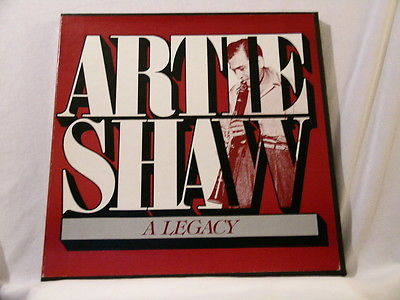
ARTIE SHAW A Legacy Hank Jones Tal Farlow Tommy Potter 4 LP box set
$
40


Favourite Auctions
To save auctions to your favourites, please login
If you don't have an account, please register
Description
ARTIE SHAW
A Legacy
Vinyl 4 LP box set. Book-Of-The-Month Club Records 71-7715. Mono, includes 16 page booklet (some writing on booklet). COVER: VG+ some writing & a few articles taped to the inside of box cover. VINYL: strong VG++ to NM- light sleeve scuff on Side 5.
ARTIE SHAW (clarinet) with Hank Jones, Tal Farlow, Joe Roland, Tommy Potter, Irv Kluger, Paul Whiteman Orchestra, and others.
While it is generally assumed that the first release of materials from the final Gramercy 5 sessions was delayed until the early 1990s, Shaw actually released fifteen tunes from those 1954 sessions as part of a four LP set entitled Artie Shaw: A Legacy through Book-of-the-Month Club Records in 1984. That this obscure release didn't garner much attention made it possible to re-release an expanded version of the sessions in the following decade, with few noticing.
For those who prefer vinyl, this set might be the best place to get many tracks of that final Gramcery 5. Included are arguably the definitive versions of the following tunes, most of them Shaw compositions (marked with * below):
Begin the Beguine
Don't Take Your Love From Me
Dancing in the Dark
The Chaser (*)
Sunny Side Up (*)
Cross Your Heart
Back Bay Shuffle (*)
How High the Moon
Star Dust
Summit Ridge Drive (*)
Stop and Go Mambo (*)
Scuttlebutt (*)
Grabtown Grapple (*)
When the Quail Come Back to San Quentin (*)
Frenesi
The Sad Sack (*)
In addition to the 1954 Gramercy 5 session material, sides six, seven, and eight contain some extremely rare recordings.
Side Six features an air check of Artie Shaw performing the Mozart Quintet with the WOR string quartet (the notes list this as being from 1947, though Simosko's discography says it was actually from 1949--see Simosko, p.115).
Side Seven contains a rare live concert of Shaw performing the Nicolai Berezowsky four movement Concerto for Clarinet with the National Youth Symphony in Carnegie Hall, 1948.
On SIDE 8: Alexander Krein's "Hebrew Sketches, No. 2, Op. 13", for clarinet and string quartet (from the WOR air checks), Shaw's own "The Blues" (the lesser-known sketch for his later "Concerto", performed with Paul Whiteman at Carnegie Hall in 1938), and his "Interlude in B-flat", recorded live in the Imperial Theatre, NYC, 1936.
The program notes, written by Gene Lees and based upon discussion with Shaw, provide a unique window for anyone seeking a deeper understanding of the man and his music. Lees was able to draw reflections of particular precision and depth. For example, at one point in their discussion Lees accused Shaw of being a hopeless romantic, to which Artie replied:
All right. Let's ask ourselves a question about 'romantic.' If 'romantic' is to believe--in spite of everything and in spite of the fact that we die at the end of it all--that there is some good to be got out of this experience called living, then, yes, I suppose I'm a romantic. I believe that living is the only crap game in town.
Look at the glory, look at the marvel, look at the wonder of life...The simple miracle of existence is the thing I just can't get past.
The entire booklet is worth reading, but here are some sample quotes:
On 'Swing' and 'The Chaser':
Let's consider that word. It's a verb, not an adjective or a noun. If jazz doesn't swing, it isn't jazz. Now here, the whole thing gets so comfortable that you forget all about tempo. The tempo takes on an identity of its own and becomes in effect another member of the group. You suddenly don't think about the music. It seems to take over, coming to life. "Swing" becomes a verb. The music begins to swing--but not the way a pendulum swings; a pendulum is always a victim of entropy, the tendency of all things in the universe to slow down. Maybe it's life against death we're talking about.
On 'Stop and Go Mambo':
This was my somewhat sardonic answer to the outbreak of mamboism...It starts with a quote from Dizzy [Gillespie] and Charlie [Parker], as my little bow to the bop era...The whole thing was meant as light humor, an element I find sadly lacking in most jazz. Point is, it's one thing to be serious, quite another to be solemn.
My last arpeggio is actually based on Scriabin's so-called mystic chord...The Notes--to take some of the mystery out of the word "mystic"--are F, B, E-flat, A, D, G. I come back down on a G major arpeggio. Try it on your bazooka sometime.
On Bebop:
Once Charlie and Dizzy and some of the others like Thelonious Monk came along and changed the entire face of jazz--actually they were the first wholly new influence since Louis Armstrong, who was a seminal figure--the music couldn't possibly have remained the same.
The point is, they had been listening to the same music I had listened to all of my life, so I never was uncomfortable with the 'new' chord structures they were playing. In the early days, if you played an E major chord (based on the third of C major), most musicians would say you were playing "out of the chord." Lots of them, in fact, would think you were deaf. Actually, though, it was an old thing as far as modern "serious" music is concerned.
After Dizzy and Charlie came along I was, for the first time in my life as a player, able to stretch out and do what I had always wanted to do but what audiences wouldn't hold still for when I was at my zenith. At that time I had to stay within the frame of what mass audiences understood. So it was a great relief when the boppers arrived. I was quite comfortable with those guys.
In addition to the 1954 Gramercy 5 session material, sides six, seven, and eight contain some extremely rare recordings.
Side Six features an air check of Artie Shaw performing the Mozart Quintet with the WOR string quartet (the notes list this as being from 1947, though Simosko's discography says it was actually from 1949--see Simosko, p.115).
Side Seven contains a rare live concert of Shaw performing the Nicolai Berezowsky four movement Concerto for Clarinet with the National Youth Symphony in Carnegie Hall, 1948.
The first movement baffled the audience totally. But by the second movement they apparently began to understand that there was was humor in the piece, and at the end of that movement they finally unbent enough to laugh. The last movement is the toughest thing I have ever played on the clarinet...There's one segment of ten or eleven seconds that I spent almost three months practicing. But the third movement [Andante Sostenuto] is the one I find a really beautiful thing.
Finally, a serious collector of Shaw's work might purchase this set for Side Eight alone. It features three pieces--Alexander Krein's "Hebrew Sketches, No. 2, Op. 13", for clarinet and string quartet (from the WOR air checks), Shaw's own "The Blues" (the lesser-known sketch for his later "Concerto", performed with Paul Whiteman at Carnegie Hall in 1938), and his "Interlude in B-flat", recorded live in the Imperial Theatre, NYC, 1936. The first is beautifully executed, and the remaining two are among the most important performances of Artie Shaw's career. For those wanting a fuller picture of Artie Shaw's genius, these performances are essential. .
PLEASE READ BEFORE PURCHASING:
WE ACCEPT PAYPAL ONLY
OUR SHIPPING COSTS INCLUDE COST FOR PACKAGING, TRANSPORTATION, AND FREIGHT.
We can NOT bear responsibility for packages lost or damaged by the Postal System. If you do not agree with this Please DO NOT purchase or bid!
GRADING. Grading is visual only unless otherwise stated. I go by Goldmine standards and try to be conservative. I will play grade on certain items only - it is just impossible for me to play grade everything I put on EBAY. MINT means factory sealed, never opened or played. NM is opened but in visually brand new, out-of-the-packaging clean condition. NM- is not NM! Its a grade above VG++ and below Near Mint - it does not imply perfect. In my terminology Scratches are feeler type and Scuffs are just cosmetic and usually inaudible.
DISCLAIMER. Due to the number of frivolous returns which were unwarranted, and due to the nature of sound recorded products that can be easily copied, there will no longer be a free return policy. I will charge a $10.00 return fee for all returns - this amount will be deducted from the Paypal refund of the returned item. If item is truly defective the entire purchase amount will be refunded as long as the item is in the same condition as it was sent.
***BUYER PAYS FOR ALL RETURN SHIPPING FEES.***
ATTENTION!!
INTERNATIONAL BUYERS: USPS has done away with Surface and Air mail. Replaced with First Class International (FCI) which is supposed to be Air Mail. Also, FCI cannot be tracked. Bidders must agree to take full responsibility if they select FCI. We can NOT bear responsibility for packages lost or damaged by the Postal System. If you do not agree with this Please DO NOT purchase or bid! If you want protection it is available using Priority Mail. Any package over 4 pounds (4 or more LPs) it is automatically sent Priority. Please wait for an invoice when purchasing 4 or more LPs so that we may get an exact shipping quote from the Post Office. Media and Priority still in effect in US..
SHIPPING FEES (USA only):
US MEDIA MAIL (USA customers only):$ 4.00 (LP) plus $1.00 per each additional LP purchased:
US PRIORITY MAIL (USA customers only): $15.00 (LP) plus $1.00 per each additional LP purchased.
INTERNATIONAL SHIPPING ONLY...........................................
CANADA ONLY (USPS First Class Mail International): $25.00 (LP) plus $2.00 per additional LP.
PRIORITY MAIL INTERNATIONAL: $60.00 (LP) plus $6.00 per each additional item purchased. This shipping method will be used when shipping weight exceeds 4 pounds (4 or more LP records).
All other combinations are actual weight and can only be provided after packing. ***SHIPPING & HANDLING COSTS ARE INCLUDED IN THESE PRICES. NOTE: I combine shipping! So buy more and save on shipping!!
WE ACCEPT PAYPAL ONLY!
price rating