ANTIQUE 1944 WORLD SERIES BASEBALL RE-CAP GRANTLAND RICE- ST. LOUIS BROWNS CARDS
$
40



Favourite Auctions
To save auctions to your favourites, please login
If you don't have an account, please register
Description
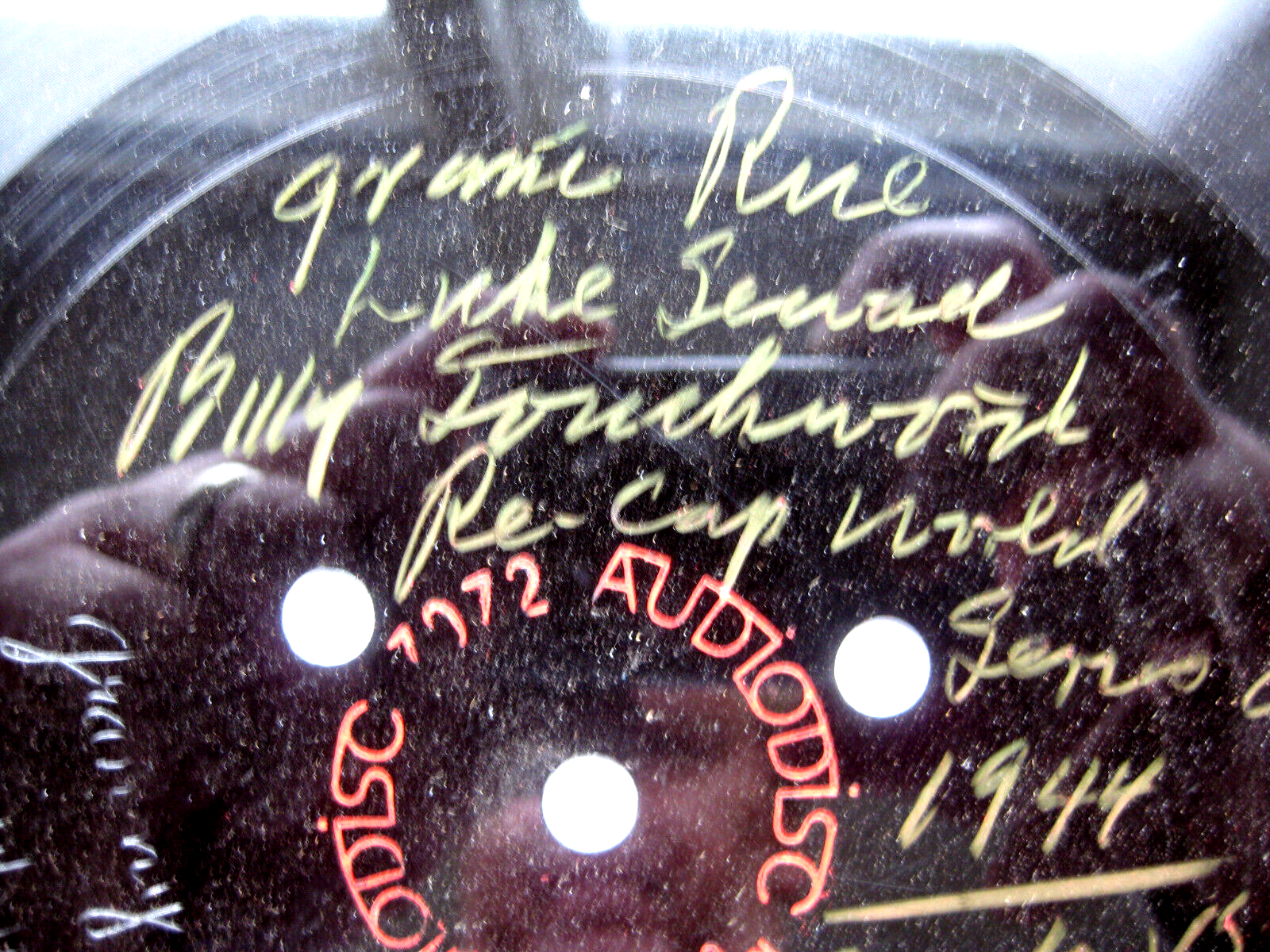
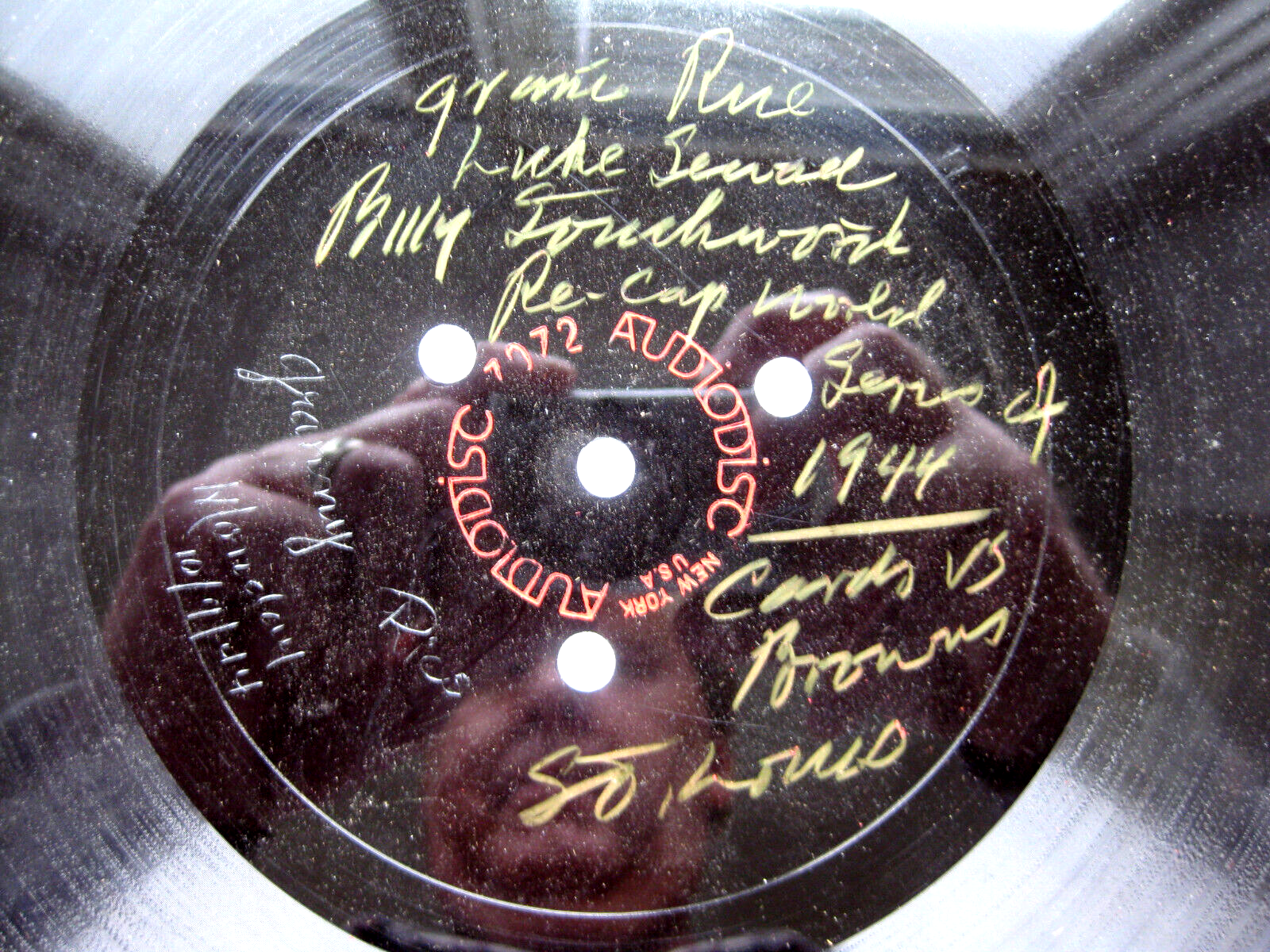
This rare and probably one of a kind left in the world 16" one sided acetate came from the estate of a radio man here in the Detroit area. I do not have a 78 rpm player that would be needed to hear this wonderful piece of history. If you do not know about acetates, they were thin metal discs covered in a glass and then recorded directly onto the surface. They were not made for repeated playing....therefore, I would suggest whoever ends up with this piece to commit it to a recording while it is still in fantastic shape. The playing surface appears EX to NEAR MINT which is amazing considering this was recorded almost 80 years ago. And while it is only a one sided recording, it does look like the flip side has something recorded on it, even though it has grease pencil crossing it out.
The best part of this recording is that it will have the voice of perhaps the greatest sports writer of all time on it - Grantland "Granny" Rice, and it appears that the managers of the St. Louis Cardinals Billy Southworth and St. Louis Browns Luke Sewell are also on it. There is no paper label, but in the center area it is etched "GRANNY RICE - MONDAY 10/9/44" In grease pencil it is written: Granny Rice Luke Sewell
Billy Southworth
Re-Cap World Series of 1944 Cards vs. Browns St. Louis
WILL BE SHIPPED IN A LARGE BOX WITH LOTS OF CARDBOARD STIFFENERS TO PROTECT THIS FRAGILE PIECE, FULLY INSURED.
ABOUT THE 1944 WORLD SERIES:
The St. Louis Browns had been members of the American League since 1902, but it took a World War for them to finally reach the World Series. Heightening the drama were their opponents (and tenants in Sportsman's Park), the St. Louis Cardinals. The Browns won their first-ever World Series game, taking the opener 2-1, thanks to George McQuinn's two-run homer in the fourth and nine strong innings from Denny Galehouse.
The Cards came back to even the Fall Classic in Game 2, but it wasn't easy. They led 2-0 after six frames, only to see the Brownies tie the contest in the seventh. It was still 2-2 in the bottom of the 10th, until Cardinals pinch-hitter Ken O'Dea singled to right field, scoring Ray Sanders with the game-winning run.
The American Leaguers struck back in Game 3, as Jack Kramer went nine innings and allowed just two (unearned) runs to capture a 6-2 victory. First baseman George McQuinn paced the hitters with three hits and two RBIs. That Brownie glory was short-lived, however, as the Cardinal pitchers hogged the credit in Games 4 and 5. In Game 4 it was Harry "the Cat" Brecheen, who tossed a complete-game nine-hitter to earn a 5-1 victory.
In Game 5. it was Mort Cooper, who trumped Brecheen with a seven-hit shutout and struck out the side in the bottom of the ninth. Brownies starter Galehouse, so good in Game 1, pitched well himself but wound up on the short end of a 2-0 stick against Cooper.
In Game 6, the Cardinals went up 3-1 in the fourth frame with three runs, only one of them earned after Browns shortstop Vern Stephens botched a throw. The scoring ended there, and Redbird right-hander Ted Wilks closed out the Series with 3 1/3 innings of perfect relief work.
ABOUT GRANTLAND RICE:
Famed Sportswriter
Henry Grantland Rice was born in Murfreesboro, Tennessee, the son of Bolling H. Rice, a cotton dealer, and his wife, Beulah Grantland Rice. His grandfather Major H. W. Rice was a Confederate veteran of the Civil War.
Rice attended Vanderbilt University in Nashville, where he was a member of both the football and baseball team, a brother in the Phi Delta Theta Fraternity, and graduated with a BA degree in 1901. After taking early jobs with the Atlanta Journal and the Cleveland News, he later became a sportswriter for the Nashville Tennessean. Afterwards he obtained a series of prestigious jobs with major newspapers in the Northeastern United States. He is best known for being the successor to Walter Camp in the selection of College Football All-America Teams beginning in 1925, and for being the writer who dubbed the great backfield of the 1924 Notre Dame Fighting Irish football team the “Four Horsemen” of Notre Dame. A Biblical reference to the Four Horsemen of the Apocalypse, this famous account was published in the New York Herald Tribune on October 18, describing the Notre Dame vs. Army game played at the Polo Grounds:
Outlined against a blue-gray October sky the Four Horsemen rode again. In dramatic lore they are known as famine, pestilence, destruction and death. These are only aliases. Their real names are: Stuhldreher, Miller, Crowley and Layden. They formed the crest of the South Bend cyclone before which another fighting Army team was swept over the precipice at the Polo Grounds this afternoon as 55,000 spectators peered down upon the bewildering panorama spread out upon the green plain below.
The passage added great import to the event described and elevated it to a level far beyond that of a mere football game. This passage, although famous, is far from atypical, as Rice’s writing tended to be of an “inspirational” or “heroic” style, raising games to the level of ancient combat and their heroes to the status of demigods. He became even better known after his columns were nationally syndicated beginning in 1930, and became known as the “Dean of American Sports Writers”. He and his writing are among the reasons that the 1920s in the United States are sometimes referred to as the “Golden Age of Sports”.
His sense of honor can be seen in his own actions. Before leaving for service in World War I, he entrusted his entire fortune, about $75,000, to a friend. On his return from the war, Rice discovered that his friend had lost all the money in bad investments, and then had committed suicide. Rice accepted the blame for putting “that much temptation” in his friend’s way. Rice then made monthly contributions to the man’s widow for the next 30 years.
According to author Mark Inabinett in his 1994 work, Grantland Rice and His Heroes: The Sportswriter as Mythmaker in the 1920s, Rice very consciously set out to make heroes of sports figures who impressed him, most notably Jack Dempsey, Babe Ruth, Bobby Jones, Bill Tilden, Red Grange, Babe Didrikson Zaharias, and Knute Rockne. Unlike many writers of his era, Rice defended the right of football players such as Grange, and tennis players such as Tilden, to make a living as professionals, but he also decried the warping influence of big money in sports, once writing in his column:
Rice authored a book of poetry, Songs of the Stalwart, which was published in 1917 by D. Appleton and Company of New York.
Rice married Katherine Hollis in 1906; they had one child, the actress Florence Rice. Rice died at the age 73 on July 13, 1954, following a stroke.
price rating

![BLACK COUNTRY COMMUNION [GLOW-IN-THE-DARK VINYL] [9/24] NEW VINYL](https://www.popsike.info/php/thumbnail.php?url=https://www.popsike.pics/pix/20211005/294439857109.jpg)