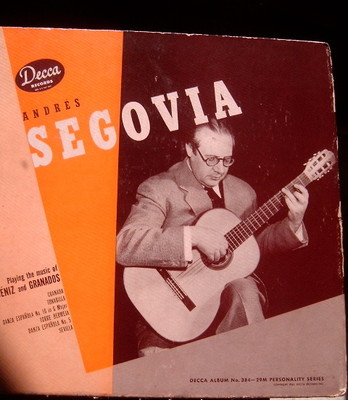
ANDRES SEGOVIA GUITAR plays Albeniz Granados 78
$
39


Favourite Auctions
To save auctions to your favourites, please login
If you don't have an account, please register
Description
WEEK 4 of 4 weeks of great auctions - THIS IS THE FINAL WEEK. I will send out your bills after end of auctions on September 17.
IMPORTANT:
PLS READ BELOW for INCREASED SHIPPING CHARGES due to Ebay Policy
I AM HAPPY COMBINE MULTIPLE SHIPMENTS.
IF YOU WIN MULTIPLE ITEMS DO NOT USE EBAY CHECK OUT in order for me to get you low combined postage. Send me an invoice request instead.
A series of great classical orchestral and instrumental performances by major conductors, composers and instrumentalists.
Most famous Player of the Spanish Classical Guitar Andres Segovia with a program of spanish Music
Albeniz: Granada (Serenata)/ Granados: Tonadilla (La Maja de Goya)
Granadosdanza Espanola No 10/Albeniz Torre Bermeja
Granados: danza Esp No 5/ Albeniz Sevillianas
3x 12" black gold Decca78 rpm records with original album 384
Condition:
EXCELLENT scuffs, some rubs on Granada, album almost like new
Andrés Torres Segovia, 1st Marquess of Salobreña (21 February 1893–2 June 1987) was a Spanish classical guitarist born in Linares, Spain. He is widely regarded as one of the most important figures for the classical guitar in the beginning and mid 20th century.
Early life
Segovia said that he began playing the guitar at the age of six.[1] Angelo Gilardino, who has worked at the Fundación Andrés Segovia in Spain, noted: "Though it is not yet completely documented, it seems clear that, since his tender childhood, he [Segovia] learnt playing as a flamenco guitarist. In fact, the first guitar he owned had formerly been played by Paco de Lucena, the greatest flamenco guitarist of the epoque, who died when Segovia was five years old. Since then, Segovia was given some instruction by Agustinillo, an amateur flamenco player who was a fan of Paco de Lucena."[2]
As a teenager, Segovia moved to the town of Granada, where he studied the guitar and soaked up the other-worldly atmosphere of the Palace at Alhambra, a Moorish relic overlooking the town which he regarded as his spiritual awakening.
[edit] Professional career
Segovia's first public performance was in Spain at the age of sixteen, and a few years later he held his first professional concert in Madrid, playing guitar transcriptions by Francisco Tárrega and some works by J.S. Bach, which he had transcribed and arranged himself. Although he was always discouraged by his family, and looked down on by many of Tárrega's pupils, he always continued to diligently pursue his studies of the guitar. Segovia's technique differed from that of Tárrega and his followers, such as Emilio Pujol. Both Segovia and Miguel Llobet (who taught Segovia several of his transcriptions of Granados' piano works) plucked the strings with a combination of his fingernails and fingertips, producing a sharper sound than many of his contemporaries. With this technique, it was possible to create a wider range of timbres, or tones, than when using the fingertips or nails alone. Historically, classical guitarists have debated which of these techniques is the best approach. While the majority now play with a combination of the fingernails/tips, some still prefer the convenience and mellower sound of flesh alone.
Segovia's status as a student of the guitar is a matter of debate among guitarists. The Segovia autobiography, written for mass consumption at the height of his career, depicts him as being self-taught. There are admissions of his seeking out Llobet's advice only for a short time when in his early twenties, but Segovia is quite clear about the lack of any real influence on his playing. Although at that age Segovia may well have been much more than a neophyte, he was still youthful enough to have received valuable instruction, and to have been significantly influenced by it. Indeed, Ronald Purcell points out that "Segovia, whose performance style and technique reveals [sic] the principles of Tárrega, was basically influenced by Llobet....This stylistic influence can be heard when comparing Llobet's Parlophone Electric recordings (Chanterelle Historical Recordings CHR 001) with Segovia's Angel recordings, ZB 3896" (Llobet 1989, 1: ii).
Purcell later states, "At the age of twenty-two he (Segovia) pursued what he considered the only direct contact to Tárrega, Llobet, for refinement of his technique and especially for the music that both he and Tárrega had written and transcribed for the guitar..."(ibid). The accuracy of this date (Segovia would have been twenty-two in 1915) seems to be somewhat questionable. A photograph taken at the exhumation of Tárrega in 1915, clearly shows Segovia at the foot of the coffin, but Llobet does not appear in the photo, and would likely have been present had he, in fact, been in Spain at the time. It may well have been another two years before Segovia began to work with Llobet and there seems to be nothing that would contradict this 1917 date.[3]
The status of the classical guitar at the beginning of the twentieth century had declined, and only in Barcelona and in the Rio de la Plata region of South America could it have been said to be of any significance. When Segovia arrived on the scene, this situation was just beginning to change, largely through the efforts of Llobet. It was in this changing milieu that Segovia, whose strength of personality and artistry coupled with new technological advances such as recording, radio, and air travel, succeeded in moving the guitar forward to become more popular again.
In 1924, Segovia visited the German luthier (guitar builder) Hermann Hauser Sr. after hearing some of his instruments played in a concert in Munich. Segovia had been impressed with the quality of Hauser's work[4] and he encouraged Hauser to copy his 1912 Manuel Ramirez guitar (an instrument generally believed to have been built by Santos Hernandez while he was foreman of the Ramirez shop). He examined and made measurements of this instrument. As Llobet, who also visited the luthier in the same year, owned an 1859 Antonio Torres, Hauser also had opportunity to examine it as well.
After World War Two Segovia became among the first to endorse the use of nylon strings instead of gut strings. This new advance allowed for greater stability in intonation, and was the final missing ingredient in the standardization of the instrument.
After Segovia's debut tour in the United States in 1928, the Brazilian composer Heitor Villa-Lobos composed his now well known Twelve Études (Douze études) and later dedicated them to Segovia. This proved to be a lasting relationship as Villa-Lobos continued to write for Segovia. He also transcribed numerous classical pieces himself and revived the pieces transcribed by men like Tárrega. Many guitarists in the Americas, however, had already been playing these same works before Segovia arrived.
In 1935, he gave a premiere of Bach's Chaconne, a difficult piece for any instrument. He moved to Montevideo performing many concerts in South America in the thirties and early forties. After the war, Segovia began to record more frequently and perform regular tours of Europe and the USA, a schedule he would maintain for the next thirty years of his life. In 1954, Joaquin Rodrigo composed Fantasía para un gentilhombre at the request of Segovia. Segovia won the 1958 Grammy Award for Best Classical Performance, Instrumentalist for his recording, Segovia Golden Jubilee.
In recognition of his contributions to music and the arts, Segovia was ennobled on 24 June 1981 by King Juan Carlos I, who elevated Segovia into the first hereditary Marquess of Salobreña, formally styled as "El señor don Andrés Torres Segovia, marqués de Salobreña" (the Most Illustrious Lord The Marquess of Salobreña). He was granted the following coat of arms: "en campo de azur sobre ondas de azur y plata, unas rocas de su color, sumadas de una torre donjonada de oro, aclarada de azur" (a field of azur on waves of azur and silver, rocks of the same color, plus a gold dungeon tower, with azur highlights).
Andres Segovia continued performing into his old age, living in semi-retirement during his 70s and 80s on the Costa del Sol. Two films were made of his life and work—one when he was 75 and the other, 84. They are available on DVD called "Andrés Segovia - in Portrait".[5]
Segovia died in Madrid of a heart attack at the age of 94. He is buried at Casa Museo de Linares, in Andalusia.
[edit] Segovia's goals
As Segovia's career and acclaim grew he determined "five purposes" as goals for his legacy. They were outlined by Segovia in Guitar Review No 32, Fall 1969:
To extract the guitar from the noisy and disreputable folkloric amusements...
I requested the living composers not in the field of guitar to write for me. This was the second of my purposes: to create a wonderful repertoire for my instrument.
My third purpose was to make the guitar known by the philharmonic public of the world.
... to provide a unifying medium for those interested in the development of the guitar. This I did through my support of the now well known international musicological journal, the Guitar Review
I am still working on my fifth and maybe the last purpose, which is to place the guitar in the most important conservatories of the world for teaching the young lovers of it, and thus securing its future.
[edit] Critical acclaim and modern perspectives
[edit] Awards and bringing the guitar to the concert stage
Segovia was awarded many prizes and honours including Ph.D, honoris causa from ten universities.[6]
Segovia was credited by his publicity for bringing the guitar (as a solo instrument) to the concert stage. While this is undoubtedly an exaggerated claim, the fact that he widened the audience for the guitar and was a vital force in helping it to gain respectability among other serious musicians, critics, and academe is beyond dispute.
He received the Danish Sonning Award in 1974 and a Grammy Lifetime Achievement Award in 1986.
Quick NOTE ON GRADING AND SHIPPING:
As you can see from my feedback, I try hard to earn your POSITIVE FEEDBACK and FIVE STAR RATINGS.
If for any reason your transaction was NOT SATISFACTORY, pls contact me and I will work something out with you. YOU WILL NEVER HAVE A REASON TO GIVE ME A NEGATIVE RATING or a LOW STAR RATING.
Quick note on grading:
The Grade (Excellent to Fair, I don't give Mint) refers to the WEAR of the record. Any other defects are stated separately, when prefaced with "HOWEVER" or "BUT" they will be significant.
When I listen to a record, I may also give it an aural grade (again E to F), and make a SUBJECTIVE judgment of the pressing quality for hiss and surface noise.
"SUPERQUIET" is basically noiseless, like a vinyl pressing.
"VERY QUIET" is an exceptionally quiet record for a given pressing.
"Quiet" is a record that is a great example without undue noise for a give pressing.
These judgments are SUBJECTIVE and will depend one the styli, phonograph etc. you use on your own equipment.
Pls check my other auctions for more great records and phonograph items:
http://shop.ebay.com/carsten_sf/m.html
http://shop.ebay.com/carsten_sf/m.html
====
Multiple item shipping: I am happy to combine items for shipment in one parcel.
If you win multiple items, pls send me an INVOICE REQUEST to calculate the correct postage. Ebay check out will not give you the multiple item discount!
Records will be packed safely between corrugated cardboard in a sturdy box with plenty of padding for safe shipment.
Shipment is usually Media Mail, unless another service is requested. Shipping is at your risk, I will be happy to insure items at your cost.
I charge actual postage plus a small fee for packing materials
As always, I guarantee your satisfaction. If you don't like the item, just return it, and I will refund the full purchase price.
If you are in the San Francisco area, I encourage pick-up in person.
EBAY NOW CHARGES 9% on all SHIPPING CHARGES
Also, USPS has increased postal rates. Since I am always shipping at cost, I am sorry to say that after keeping my shipping rates stable for 5 years, I unfortunately now have to increase the prices.
However, if you are interested in lowering you shipping cost, pls send me a message, and I may be able to arrange for better rates !!!
Here a quick breakdown of my costs, you see that due to the new Ebay policy you will pay anywhere from $.50 to $.80 in additional Ebay fees on the first record
10" record 12" record 12" Album of 4 records Total Weight 1.5 lbs 1.9 lbs 5.5 lbs Box 1.17 1.21 1.37 Cardboard Squares 3 0.97 3 1.00 4 1.33 Media Mail 2.82 2.82 4.46 Sum 4.96 5.03 7.16 Ebay Fee on Shipping 9% 0.45 0.45 0.64 Paypal Fee 2.9% 0.14 0.15 0.21 Total 5.55 5.62 8.01US Domestic Shipping:
Here is a guideline for US Media Mail Shipping:
Prices below are for regular 78 rpm records. Up to about 5 records, I will ship Edison Discs for the same rates. Albums from Album Sets count as 1 record. Above that and for international shipments, it will be actual weight plus a small packing charge (1-3$ depending on size of shipment)
1 record: 4.75$
2 records: 5.75$
5 records: 7.50$
10 records: 9.50$
MANY MORE RECORDS: Don't worry. I safely ship 40 - 50 pounds of records double boxed in moving boxes, and even then Media Mail will probably not exceed 30$.
The numbers above include the 9% Ebay fee on shipments.
Pls ignore the automatically calculated prices on the ebay site, as I will weigh every parcel and charge based on actual weight.
Please send me a message if you would like to lower your shipping rates!
International Buyers:
All'attenzione degli acquirenti italiani:
ATTENTION TO ITALIAN BUYERS:
Due to rare problems with delivery in ITALY, I will NOT GUARANTEE delivery of parcels sent by US Postal Service First Class and Priority Mail. If you prefer secure delivery, I will be happy to quote you either Registered Mail or shipment by FEDEX
I am very happy to ship records worldwide.
Prices below are for regular 78 rpm records. For Edison Discs in international shipments, it will charge for the actual weight plus a small packing charge (1-2$) - for small quantities, it will not be much different from the charge for regular 78s.
Pls contact me for a shipping estimate, or send me an invoice request after close of auction.
Be aware that US Postal Rates can be high. Here are some examples.
Your best bet is the Large Priority box, everything that fits into a 12"x12"x5 1/2" box up to 20 pounds ships for 60$ (35$ Canada) worldwide.
However, I can get competitive rates from FedEx and the US Postal service for any kind of parcel weight
Africa, Eastern Asia and Japan as well as Europe
1 record = 2 lbs $25 - $28
4 lbs = $37
20 lbs or all that fits into a 12"x12"x 5 1/2" box ((12" albums won't fit)= $60
I may be able to get some better FedEx rates.
Pls email with your address for an estimate.
Canada
1 record = 2 lbs $ 11 - $13
4 lbs = 22$
20 lbs or all that fits into a 12"x12"x 5 1/2" (12" albums won't fit)= $38
I may be able to get some better FedEx rates.
Pls email with your address for an estimate.
To estimate your shipment, pls go to
http://www.usps.com/tools/calculatepostage/welcome.htm?from=home_header&page=calculatepostage
My zip code is 94107.
Assume 1 pound per record plus 1 pound for packing.
AND AGAIN -THANK YOU FOR YOUR INTEREST
As you can see from my feedback, I take great care in presenting, grading and shipping your items. I really want you to be happy with the purchase. If you feel that anything is wrong with the item or the shipping, contact me and we will work it out !!!
Pls contact me with your country, home town and postal code before bidding for an estimate.
=====
As always, I would appreciate any suggestions and corrections from you, pls contact me with any question.
Thank you very much, and good luck bidding !!!
price rating





![The Nothing - Tired Of Tomorrow [New Vinyl LP] Colored Vinyl, Yellow, Anniversar](https://www.popsike.info/php/thumbnail.php?url=https://www.popsike.pics/pix/20220824/134208768636.jpg)