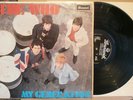
ALEXIS KORNER'S BLUES INCORPORATED ORIG 1965 UK ACE OF CLUBS BLUES LP EX COND
$
83


Favourite Auctions
To save auctions to your favourites, please login
If you don't have an account, please register
Description
ALEXIS KORNER'S BLUES INCORPORATED~ORIG 1965 UK ACE OF CLUBS BLUES LP~EX COND!!
Product Description
Alexis Korner's Blues Incorporated – Alexis Korner's Blues Incorporated
Ace Of Clubs – ACL 1187
EXTREMELY RARE ORIGINAL UK PRESSING FROM 1965!
THE ONLY COPY WE'VE EVER SEEN!
LAMINATED COVER IS IN VG+/VG++ CONDITION WITH MODERATE RINGWEAR BUT NO SEAM SPLITS!
VINYL IS IN EXCELLENT CONDITION WITH ONLY A COUPLE LIGHT SCUFFS!
AMAZING SHAPE FOR THIS 49 YEAR OLD LP!!!
TRACKLIST:
A1 Blue Mink
A2 Rainy Tuesday
A3 Yogi
A4 Sappho
A5 Navy Blue
B1 Royal Dooji
B2 Preachin' The Blues
B3 Captain's Tiger
B4 Little Bit Groovy
B5 Anything For Now
B6 Chris Trundle's Habit
B7 Trundlin'
Copyright (c) – The Decca Record Company Limited
Made By – British Celanese Limited
Printed By – Robert Stace
Published By – Fremont Music Co.
Credits
Alto Saxophone, Tenor Saxophone – Art Themen
Bass – Mike Scott (8)
Drums – Phil Seamen
Lead Guitar – Alexis Korner
Liner Notes – Charles Fox (3)
Piano – Johnny Parker (4)
Tenor Saxophone – Dick Heckstall-Smith
Notes
Made in England
? 1965, The Decca Record Company Limited, London.
Red unboxed label. Laminated front single sleeve.
On back sleeve:
"Laminated with 'Clarifoll' made by British Celanese Limited".
Without Alexis Korner, there still might have been a British blues scene in the early 1960s, but chances are that it would have been very different from the one that spawned the Rolling Stones, nurtured the early talents of Eric Clapton, and made it possible for figures such as John Mayall to reach an audience. Born of mixed Turkish/Greek/Austrian descent, Korner spent the first decade of his life in France, Switzerland, and North Africa, and arrived in London in May of 1940, just in time for the German blitz, during which Korner discovered American blues. One of the most vivid memories of his teen years was listening to a record of bluesman Jimmy Yancey during a German air raid. "From then on," he recalled in an interview, "all I wanted to do was play the blues."
After the war, Korner started playing piano and then guitar, and in 1947 he tried playing electric blues, but didn't like the sound of the pick-ups that were then in use, and returned to acoustic playing. In 1949, he joined Chris Barber's Jazz Band and in 1952 he became part of the much larger Ken Colyer Jazz Group, which had merged with Barber's band. Among those whom Korner crossed paths with during this era was Cyril Davies, a guitarist and harmonica player. The two found their interests in American blues completely complementary, and in 1954 they began making the rounds of the jazz clubs as an electric blues duo. They started the London Blues and Barrelhouse Club, where, in addition to their own performances, Korner and Davies brought visiting American bluesmen to listen and play. Very soon they were attracting blues enthusiasts from all over England.
Korner and Davies made their first record in 1957, and in early 1962, they formed Blues Incorporated, a "supergroup" (for its time) consisting of the best players on the early-'60s British blues scene. Korner (guitar, vocals), Davies (harmonica, vocals), Ken Scott (piano), and Dick Heckstall-Smith (saxophone) formed the core, with a revolving membership featuring Charlie Watts or Graham Burbridge on drums, Spike Heatley or Jack Bruce on bass, and a rotating coterie of guest vocalists including Long John Baldry, Ronnie Jones, and Art Wood (older brother of Ron Wood). Most London jazz clubs were closed to them, so in March of 1962 they opened their own club, which quickly began attracting large crowds of young enthusiasts, among them Mick Jagger, Keith Richards, and Brian Jones, all of whom participated at some point with the group's performances; others included Ian Stewart, Steve Marriott, Paul Jones, and Manfred Mann. In May of 1962, Blues Incorporated was invited to a regular residency at London's Marquee Club, where the crowds grew even bigger and more enthusiastic. John Mayall later credited Blues Incorporated with giving him the inspiration to form his own Bluesbreakers group.
R&B from the Marquee
Record producers began to take notice, and in June of 1962 producer Jack Good arranged to record a live performance by the band. The resulting record, R&B from the Marquee, the first full-length album ever made by a British blues band, was released in November of 1962. The album consisted of largely of American standards, especially Willie Dixon numbers, rounded out with a few originals. At virtually the same time that Blues Incorporated's debut was going into stores, Cyril Davies left the group over Korner's decision to add horns to their sound. Korner soldiered on, but the explosion of British rock in 1963, and the wave of blues-based rock bands that followed, including the Rolling Stones, the Animals, and the Yardbirds undercut any chance he had for commercial success. His more studied brand of blues was left stranded in a commercial backwater -- there were still regular gigs and recordings, but no chart hits, and not much recognition. While his one-time acolytes the Rolling Stones and the Cream made the front pages of music magazines all over the world, Korner was relegated to the blues pages of England's music papers, and, though not yet 40, to the role of "elder statesman."
For a time, Korner hosted Five O'Clock Club, a children's television show that introduced a whole new generation of British youth to American blues and jazz. He also wrote about blues for the music papers, and was a detractor of the flashy, psychedelic, and commercialized blues-rock of the late '60s, which he resented for its focus on extended solos and its fixation on Chicago blues. He continued recording as well, cutting a never-completed album with future Led Zeppelin vocalist Robert Plant in early 1968. Korner's performing career in England was limited, but he could always play to large audiences in Europe, especially in Scandinavia, and there were always new Korner records coming out. It was while touring Scandinavia that he first hooked up with vocalist Peter Thorup, who became Korner's collaborator over the next several years in the band New Church. After his dismissal from the Rolling Stones, Brian Jones considered joining New Church; Korner, however, rejected the idea, because he didn't want his new band to be caught up in any controversy. In 1972, he became peripherally involved in the breakup of another band, inheriting the services of Boz Burrell, Mel Collins, and Ian Wallace when they quit King Crimson.
The image included with the auction is a scan of the actual item but, due to size limitations of the scanner, the edges of the item may have been cropped.
If you have questions, BEFORE you buy, email us.
In Your Ear has been selling music to the masses since 1982. We carry new and used LPs, CDs, DVDs, 45s, 12" singles, posters and who-knows-what-else! We have 2 physical locations in Massachusetts and 1 in Rhode Island:
957 Commonwealth Avenue, Boston, MA. 02215
72 Mt. Auburn Street, Cambridge, MA. 02138
462 Main Street, Warren, RI 02885
SHIPPING PRICES ARE AUTOMATICALLY CALCULATED BASED ON YOUR GEOGRAPHIC LOCATION. PLEASE NOTE: WE PACK OUR LPs WITH LOTS OF ADDED PADDING, USING OTHER EMPTY LPs SLEEVES TO REINFORCE THE MAILER AND PROTECT THE ITEM BEING SHIPPED. THIS ADDS CONSIDERABLY TO THE WEIGHT AND, THEREFORE, TO THE COST OF SHIPPING. We're proud of our positive feedback. Click here to see what other customers say about us: http://feedback.ebay.com/ws/eBayISAPI.dll?ViewFeedback2&userid=in-your-ear%21&ftab=AllFeedback&myworld=true&rt=nc
RECORD GRADING POLICY
MINT = like new or near new with only one or two small insignificant defects, a 9 or better on a 1-10 scale
EXCELLENT = Would be Near Mint, except for a couple of light hairlines or scuffs, which do not affect play
VG++ = still a very nice record with all or nearly all of its original gloss but may have a few more light, surface marks, hairlines, needle tracks or the like which should not materially affect play
VG+ = a nice, but used record that may have a series of light scuffs or scratches. It probably plays with a few pops, but has no serious problems.
VG = a well-used record that still should sound OK when played, but may have moderate surface noise, pops, etc.
VG- = a very well-worn record that plays through without skipping, but will do until a better copy comes along.
Good = not actually good at all but probably will play through but with much in the way of surface noise, pops, crackles, etc. Still, will have no cracks, chips or the like
Fair = you are getting this record just to own but not to play
Poor = the sky's the limit, generally I will discard a record this bad (and sell the cover, jacket or sleeve alone) unless the label holds some particular interest
For listings for our Boston/Cambridge stores, CLICK HERE.
For additional listings for our Rhode Island store, CLICK HERE.
Don't forget to visit our "About Me" page to find out lots more about our online and retail stores!
Bid with confidence at In Your Ear! Check out our customer feedback. CLICK HERE!
inkfrog terapeak
i000000
price rating