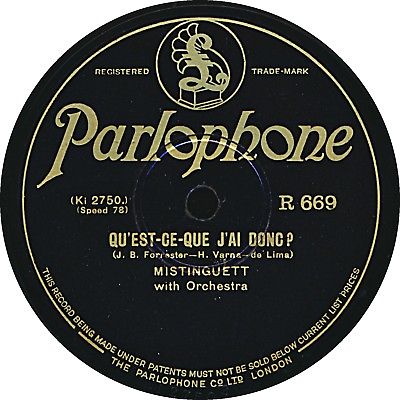
78 RPM - Mistinguett - Qu'est-ce que j'ai donc / I'm on my Way Home - Paris 1929
€
32
$
37


Favourite Auctions
To save auctions to your favourites, please login
If you don't have an account, please register
Description
78 RPM - Mistinguett - Qu'est-ce que j'ai donc / I'm on my Way Home - Paris 1929
Please see Foto below!
Recorded Paris, 1929 - Side 2 englisch sung
Mistinguett with Orchester Seite 2 with Henry Garat and Walter Horne
No. E 1126 - More about condition/ grading see below
Side 1: Qu'est-ce que j'ai donc +
Side 2: I'm on my Way Home +
Parl R 669, Great Britain, Condition 2- / 2-- (Optic / accoustic) OH braucht etwas höhere Auflage ! 105 ! needs little mor weight for the tone-poor
Condition 2- / 2-- (Optic / accoustic) 105!
Good Condition with good Sound. Minimal signs of use. Plays only little bit badly then it looks. Makes little background Sound. Sometimes it´s possible to work against with bigger needle like 105 my.
More 78 - Records you´ ll find under www.rcc78.de
TRIXUM: Mobil-optimierte Auktionsvorlagen und Bilder-Hosting
Shipping:
Germany 6 Euro / Europe 10 Euro / Rest of the World 10 Euro
Worldwide shipping!
Condition:
Like in School. Note 1-6. 1 = very good 6 = extremely worse. My best Number normally is 2 cause 1 would be new and that´s nearly impossible at 78´s!
For every record you will find two numbers the first for optic and the second for acoustic condition. In the case the acoustic Number is more bad, the sound is not so good like we can see . For example a record is 2- / 3+ that means good conditions but it makes a bit background sound.The Size of Scratches and Needleholes will be marked by how often you can hear an Sound for Example NL 4x All Records 10 Inch ore told otherwise. Country of Pressing by Car -Number, for Example D for Deutschland Germany. US - United States.
Optical
+ 2 - Not used only one ore two times the pleasure of every Collector
+ 3 - Normal used not grey normally
+ 4 - Very often used Grey
+ 5 - For Documentation but it runs
6 For Documentation do not run
Acoustic
+ 2 - No Background-Sound
+ 3 - Background-Sound but good to hear
+ 4 - All sorts of Background Sound but all to understand
+ 5 - terrible Sound
Abbreviations:
+ with Singing, for Example. F+ F - Foxtrot sF - Slowfox Ser - Serenade Be - Beguine Cha - Chanson T - Tango Bl - Blues W - Waltz Sa - Samba Ch - Charleston R - Rumba Psd - Pasodoble P - Polka Ml - Marschlied - March Ts -Twostep Os - Onestep Qs - Quickstep L - Lied Sh - Shimmy Boo - Boogie Woogie Rs - Randschaden nicht in Rille - Edgedamage not in groove Ls - Labelschaden gro? oder klein - Labeldamage big or little Nlf - Nadell?ufer -nicht h?rbar - Needlerunner not to hear Scr - Scratch - to hear lscr - light scratch not to hear hcr - haircrack Lam-Hcr Laminatetd
haircrack for Example at american Columbias, normaly no Problem Int Hcr - in the middle of Record normally no Problem cr - Crack Nl - Needlehole kl - klein - little gr - Gro? - big Fst - Fehlstelle z.B. Dreck in Rille - little dirty point or something like that Bl - Blase - bubble Vsch - Verschmutzung dirt / mud hrb - h?rbar - to hear O.H.- Originalh?lle / Original Sleeve 4x how often you hear a little soundor clix for example in a Needlehole Nl o. scr Nk - Nachkrieg - Afterwar pressing from a postwar recording especcially in German Dancemusik. Start - rough Start at the beginning *** - Stars, Rareness of a Record - * = often bis ****** = extremly rare 105 - Better Sound with a needle of 105 my ( normal 63 my) bl Pr. - blistery Pressing Sol – Sticker on Label Wol – Writing on Label
price rating


