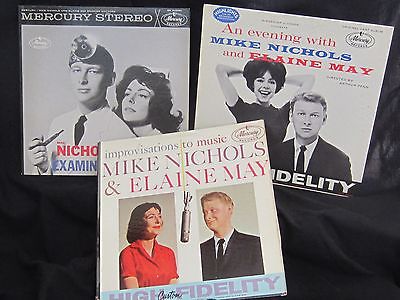
3 LP Mike Nichols Elaine May Improvisations To Music/An Evening /EXAMINE DRs
$
33


Favourite Auctions
To save auctions to your favourites, please login
If you don't have an account, please register
Description
THE 3 lp VINYL LOT FOR SALE
- Nichols and May- Improvisations to Music (1959) Mercury
- Nichols and May- An Evening with Mike Nichols and Elaine May (1960) Mercury
- Nichols and May- Mike Nichols & Elaine May Examine Doctors (1962) Mercury MG 20680/SR 60680
PRIVATE OWNER/ SATISFACTION GUARANTEED OR MONEY BACK/ ALL ORIGINAL INNER SLEEVES...
Mike Nichols (born Mikhail Igor Peschkowsky; November 6, 1931 – November 19, 2014) was a German-bornAmerican film and theatre director, producer, actor and comedian. He began his career in the 1950s with the improv troupe, the Compass Players, predecessor of the Second City in Chicago and as one half of the comedy duo Nichols and May, along with Elaine May. May was also in the Compass. In 1968 he won the Academy Award for Best Directorfor the film The Graduate. His other films include Who's Afraid of Virginia Woolf?, Catch-22, Carnal Knowledge,Silkwood, Working Girl, The Birdcage, Closer, Charlie Wilson's War (his final picture), and the TV mini-series Angels in America. He also staged the original theatrical productions of Barefoot in the Park, Luv, The Odd Couple andSpamalot.
Nichols was one of a small group of people who have won an Emmy, Grammy, Oscar, and Tony Award. His other honors included the Lincoln Center Gala Tribute in 1999, the National Medal of Arts in 2001,[1] the Kennedy Center Honors in 2003 and the AFI Life Achievement Award in 2010.
Contents
[hide]- 1 Early life and education
- 2 Nichols and May
- 3 Career as a director
- 3.1 1960s
- 3.2 1970s
- 3.3 1980s
- 3.4 1990s
- 3.5 2000s
- 3.6 2010s
- 4 Personal life
- 5 Work
- 5.1 Broadway stage productions
- 5.2 Filmography
- 5.3 Discography
- 6 Awards and honors
- 7 See also
- 8 References
- 9 External links
Early life and education[edit]
Mike Nichols was born Mikhail Pavlovich Peschkowsky[2] in Berlin, Germany, the son of Brigitte (née Landauer) and Pavel Peschkowsky, a physician.[2][3] His father was born in Vienna, Austria, to a Russian Jewish immigrant family. Nichols' father's family had been wealthy and lived in Siberia, leaving after the Russian Revolution, and settling in Germany around 1920.[2] Nichols' mother's family were German Jews.[2] His maternal grandparents were anarchistGustav Landauer and author Hedwig Lachmann. Nichols is a third cousin twice removed of scientist Albert Einstein, through Nichols' mother.[2]
In April 1939, when the Nazis were arresting Jews in Berlin, seven-year-old Mikhail and his three-year-old brother Robert were sent alone to the United States to meet up with their father, who had fled months earlier. His mother eventually joined the family, escaping through Italy in 1940.[4] The family moved to New York City on April 28, 1939.[2][5]His father, whose original Russian name was Pavel Nikolaevich Peschkowsky, changed his name to Paul Nichols, Nichols derived from his Russian patronymic, and set up a successful medical practice in Manhattan, enabling the family to live near Central Park.[6][7]
Nichols became a naturalized citizen of the United States in 1944 and attended public elementary school in Manhattan (PS 87).[8] After graduating from the Walden School, a private progressive school on Central Park West, Nichols briefly attended New York University before dropping out. In 1950, he enrolled in the pre-med program at the University of Chicago.[7]
While attending the University of Chicago in the 1950s, Nichols began skipping class to attend theatrical activities. Nichols first met Elaine May at this time when she criticized his acting in a performance of August Strindberg's Miss Julie. At the University, Nichols made his theatrical debut as a director with a performance of William Butler Yeats'Purgatory.[7] Also there he met Susan Sontag (then known as Susan Rosenblatt), who considered Nichols her "best friend." [9] In 1954, Nichols dropped out of the University of Chicago and moved back to New York City, where he was accepted into the Actors Studio and studied under Lee Strasberg.
While in Chicago in 1953, Nichols joined the staff of struggling classical music station WFMT, 98.7 FM, as an announcer. Co-owner Rita Jacobs asked Nichols to create a folk music program on Saturday nights, which he named "The Midnight Special." He hosted the program for two years before leaving for New York City. Nichols frequently invited musicians to perform live in the studio and eventually created a unique blend of "folk music and farce, showtunes and satire, odds and ends," along with his successor Norm Pellegrini. The program endures today in the same time slot.[10]
Nichols and May[edit]
Nichols and May Main article: Nichols and MayIn 1955 Nichols was invited to join the Compass Players, which was predecessor to Chicago's Second City and whose members included Elaine May, Shelley Berman, Del Close, and Nancy Ponder,[7][11] directed by Paul Sills.
Nichols moved back to Chicago to perform comedy with Compass and started doing improvisational routines with Elaine May, which led to the formation of the comedy duo Nichols and May in 1958, which they began performing in New York City. Three records of their routines, best-sellers at the time, were released and the duo made appearances in nightclubs, on radio and on several television programs. They were invited to audition for Jack Rollins, who later became Woody Allen's manager and producer, and he was impressed, stating: "Their work was so startling, so new, as fresh as could be. I was stunned by how really good they were, actually as impressed by their acting technique as by their comedy. . . I thought, My God, these are two people writing hilarious comedy on their feet![12]:340
In 1960 Nichols and May opened the Broadway show An Evening With Mike Nichols and Elaine May, directed by Arthur Penn. The LP album of the show won the 1962 Grammy Award for Best Comedy Album. Personal idiosyncrasies and tensions eventually drove the duo apart to pursue other projects in 1961. About their sudden breakup, director Arthur Pennsaid, "They set the standard and then they had to move on,"[12]:351 while talk show host Dick Cavett said "they were one of the comic meteors in the sky."[12]:348 Comedy historian Gerald Nachman describes the effect of their break-up on American comedy:
Nichols and May are perhaps the most ardently missed of all the satirical comedians of their era. When Nichols and May split up, they left no imitators, no descendants, no blueprints or footprints to follow. No one could touch them.[12]:319
They later reconciled and worked together many times, such as on the unsuccessful A Matter of Position, a play written by May and starring Nichols. May scripted Nichols' films The Birdcage and Primary Colors. They appeared together at President Jimmy Carter's inaugural gala and in a 1980 New Haven stage revival ofWho's Afraid of Virginia Woolf? with Swoosie Kurtz and James Naughton.[13]
Career as a director[edit]
This section needs additional citations for verification. Please help improve this article by adding citations to reliable sources. Unsourced material may be challenged and removed. (November 2014)1960s[edit]
Theater program from 1961After the professional split with May, Nichols went to Vancouver, B.C., to work in the theater directing a production of The Importance of Being Earnest and acted in a revival of George Bernard Shaw's St. Joan.[7]
In 1963, Nichols was chosen to direct Neil Simon's Barefoot In The Park. He realized at once that he was meant to be a director, saying in a 2003 interview: “On the first day of rehearsal, I thought, ‘Well, look at this. Here is what I was meant to do.’ I knew instantly that I was home”.[14] Barefoot in the Park was a big hit, running for 1530 performances and earning Nichols a Tony Award for his direction.[7] This began a series of highly successful plays on Broadway (often from works by Simon) that would establish his reputation. After an off-Broadway production of Ann Jellicoe's The Knack, Nichols directedMurray Schisgal's play Luv in 1964. Again the show was a hit and Nichols won a Tony Award (shared with The Odd Couple). In 1965 he directed another play by Neil Simon, The Odd Couple. The original production starred Art Carney as Felix Ungar and Walter Matthau as Oscar Madison. The play ran for 966 performances and won Tony Awards for Nichols, Simon and Matthau.[7] Overall, Nichols won eight Tony Awards: six for Best Director of either a play or a musical, one for Best Play and one for Best Musical.
Elaine May, Mike Nichols andDorothy Loudon (r.) in 1959By 1966, Nichols was a star director and Time magazine called him "the most in-demand director in the American theatre."[7] Although he had no experience in filmmaking, Warner Bros. invited Nichols to direct a screen adaptation of Edward Albee's Who's Afraid of Virginia Woolf? starring Elizabeth Taylor and Richard Burton. The film was a another great success, winning five Academy Awards with thirteen nominations (including Nichols first nomination for Best Director), three BAFTA Awards, and was critically acclaimed, with critics calling Nichols "the new Orson Welles."[7]
His next film was The Graduate (1967), starring Dustin Hoffman, Anne Bancroft and Katharine Ross. On its release, it grossed $50 million, making it both the highest grossing film of 1967 and one of the biggest grossing films in history up to that date. It was nominated for seven Academy Awards, including Best Picture, Best Actor, Best Actress, Best Supporting Actress, Best Adapted Screenplay and Best Cinematography. Nichols won the Academy Award for Best Director. Hoffman credits Nichols for having taken a great risk in giving him, a relatively unknown, the starring role: "I don't know of another instance of a director at the height of his powers who would take a chance and cast someone like me in that part. It took tremendous courage."[15]
Nichols had previously returned to Broadway to direct The Apple Tree, starring Second City alumna, Barbara Harris. After doing The Graduate, he again returned to the Broadway stage with a revival of Lillian Hellman's The Little Foxes in 1967, which ran for 100 performances.[16] He then directed Neil Simon's Plaza Suite in 1968, earning him another Tony Award for Best Director. He also directed the short film Teach Me! (1968), which starred actress Sandy Dennis.
1970s[edit]
Nichols next film was a big-budget adaptation of Joseph Heller's novel Catch-22 (1970) followed by Carnal Knowledge (1971) starring Jack Nicholson, Ann-Margret,Art Garfunkel and Candice Bergen. The latter film was highly controversial upon release because of the casual and blunt depiction of sexual intercourse.
Nichols then returned to Broadway to direct Neil Simon's The Prisoner of Second Avenue in 1971. The play won Nichols another Tony Award for Best Director. In 1973 Nichols directed a revival of Anton Chekhov's Uncle Vanya on Broadway starring George C. Scott and with a new translation by himself and Albert Todd.[7] In 1973 Nichols directed The Day of the Dolphin starring George C. Scott, based on the novel A Sentient Animal by Robert Merle and adapted by Buck Henry. The film was not successful financially and received mixed reviews from critics.[7] Nichols next directed The Fortune (1975), starring Warren Beatty, Jack Nicholson andStockard Channing. Again, the film was a financial failure and received mostly negative reviews. It was Nichols last feature narrative film for eight years.[7]
Nichols then returned to the stage with two moderately successful productions in 1976. David Rabe's Streamers opened in April and ran for 478 performances.Trevor Griffiths's Comedians ran for 145 performances. Also in 1976 Nichols worked as Executive Producer to create the television drama Family for ABC. The series ran until 1980.
In 1977 Nichols produced the original Broadway production of the hugely successful musical Annie, it ran for 2,377 performances until 1983. Nichols won the Tony Award for Best Musical. Later in 1977, Nichols directed D.L. Coburn's The Gin Game. The play ran for 517 performances and won a Tony Award for Best Actress for Jessica Tandy.
1980s[edit]
In 1980 Nichols directed the documentary Gilda Live, a filmed performance of comedian Gilda Radner's one-woman show Gilda Radner Live on Broadway. It was released at the same time as the album of the show, both of which were successful. Nichols then directed two unsuccessful shows: Billy Bishop Goes to War opened in 1980 and closed after only twelve performances, and Neil Simon's Fools, in 1981, which closed after forty performances.
Returning to Hollywood, Nichols career rebounded in 1983 with the film Silkwood, starring Meryl Streep, Cher and Kurt Russell, based on the life of whistleblowerKaren Silkwood. The film was a financial and critical success, with film critic Vincent Canby calling it "the most serious work Mike Nichols has yet done."[7] The film received five Academy Award nominations, including Best Director for Nichols.
Later that year Nichols and Peter Stone helped to fix up and rewrite the musical My One and Only just days before its Boston premiere. The show eventually went to Broadway and ran for 767 performances, winning Tony Awards for Best Actor, Best Choreography (both for Tommy Tune) and best Supporting Actor (Charles "Honi" Coles).[17]
In 1984 Nichols directed the Broadway premiere of Tom Stoppard's The Real Thing. The New York Times critic Frank Rich wrote that "The Broadway version of The Real Thing - a substantial revision of the original London production - is not only Mr. Stoppard's most moving play, but also the most bracing play that anyone has written about love and marriage in years."[18] The play was nominated for seven Tony Awards and won five, including a Best Director Tony for Nichols.
Nichols quickly followed this success with the Broadway premiere of David Rabe's Hurlyburly, also in 1984. It was performed just two blocks away from the theater showing The Real Thing. It was nominated for three Tony Awards and won Best Actress for Judith Ivey.[7]
In 1983 Nichols had seen comedian Whoopi Goldberg's one woman show, The Spook Show and wanted to help her expand it. Goldberg's self-titled Broadway show opened in October 1984 and ran for 156 performances. Rosie O'Donnell said that Nichols had discovered Goldberg while she was struggling as a downtown street artist: "He gave her the entire beginning of her career and recognized her brilliance before anyone else," O’Donnell added.[19]
In 1986 Nichols directed the Broadway premiere of Andrew Bergman's Social Security. The show ran for 188 performances. That same year Nichols made the filmHeartburn starring Meryl Streep and Jack Nicholson, and got mixed reviews. In 1988 Nichols completed two feature films. The first was an adaptation of Neil Simon's autobiographical stage play Biloxi Blues starring Matthew Broderick, also receiving mixed critical reviews. Later in 1988, Nichols directed one of his most successful films, Working Girl starring Melanie Griffith, Harrison Ford and Sigourney Weaver. Working Girl was a huge hit upon its release. It also received mostly positive reviews from critics with an 84% rating at Rotten Tomatoes and a 73 metascore at Metacritic. It was nominated for six Academy Awards (including Best Director for Nichols) and won the Academy Award for Best Song for Carly Simon's "Let the River Run".
1990s[edit]
In the 1990s, Nichols' directed several more successful, well-received films including Postcards from the Edge (1990) starring Meryl Streep and Shirley MacLaine;Primary Colors (1998) starring John Travolta and Emma Thompson; and The Birdcage (1996), an American remake of the 1978 French film La Cage aux Follesstarring Robin Williams, Nathan Lane, Gene Hackman and Dianne Wiest. Both The Birdcage and Primary Colors were written by Elaine May, Nichols's comedy partner earlier in his career. Other films directed by Nichols include Regarding Henry (1991) starring Harrison Ford and Wolf (1994) starring Jack Nicholson andMichelle Pfeiffer. When he was honored by Lincoln Center in 1999 for his life's work, Elaine May--speaking once again as his friend--served up the essence of Nichols with the following:
"So he’s witty, he’s brilliant, he’s articulate, he’s on time, he’s prepared and he writes. But is he perfect? He knows you can’t really be liked or loved if you’re perfect. You have to have just enough flaws. And he does. Just the right, perfect flaws to be absolutely endearing."[20]
2000s[edit]
In the 2000s Nichols directed the films What Planet Are You From? (2000), Closer (2004) and Charlie Wilson's War (2007), an acclaimed political drama that was ultimately his final feature film. He also directed widely acclaimed adaptations of Wit (2001) and Angels in America (2003) for television, winning Emmy Awards for both of them.[21]
Nichols was a contributing blogger at The Huffington Post. He was also a co-founder of The New Actors Workshop in New York City, where he occasionally taught.[22] In addition, he remained active in the Directors Guild of America, interviewing fellow film director Bennett Miller on stage in October 2011 after the Guild's screening of Miller's Moneyball
2010s[edit]
In 2012, Nichols won the Best Direction of a Play Tony Award for Arthur Miller's Death of a Salesman. In April 2013, it was announced that he would direct Daniel Craig and Rachel Weisz in a Broadway revival of Harold Pinter's Betrayal. The play was scheduled to begin its limited run on October 1 at the Ethel Barrymore Theatre, opening on November 3 through January 5, 2014.[23] Nichols was also in talks to direct a film adaptation of Jonathan Tropper's novel One Last Thing Before I Go. The film was to be produced by J.J. Abrams, who previously wrote the Nichols-directed film Regarding Henry (1991).[24]
Personal life[edit]
Nichols was married four times. His first wife was Patricia Scott; they were married from 1957 to 1960. He was married to Margo Callas from 1963 to 1974, producing a daughter, Daisy Nichols. His third marriage, to Annabel Davis-Goff, produced two children, Max Nichols and Jenny Nichols. They were divorced in 1986. He married ABC World News anchor Diane Sawyer on April 29, 1988.[citation needed]
Nichols' grandfather, Gustav Landauer, was a leading theorist on anarchism in the early 20th century. According to research done by Professor Henry Louis Gates, Jr., of Harvard University, in 2010 for the PBS series Faces of America, Nichols is related to Albert Einstein who was a third cousin on his mother's side.[4]
Among Nichols' personal pursuits was a lifelong interest in Arabian horses.[25][26] From 1968 to 2004, he owned a farm in Connecticut and was a noted horse breeder.[27] Over the years, he also imported quality Arabian horses from Poland, some of which later resold for record-setting prices.[28]
Nichols died of a heart attack on November 19, 2014, at his apartment in Manhattan.[29][30]
Work[edit]
Broadway stage productions[edit]
- Barefoot in the Park (1963)
- Luv (1964)
- The Odd Couple (1965)
- The Apple Tree (1966)
- The Little Foxes (1967)
- Plaza Suite (1968)
- The Prisoner of Second Avenue (1971)
- Uncle Vanya (1973)
- Streamers (1976)
- Comedians (1976)
- Annie (1977)
- Billy Bishop Goes to War (1980)
- Fools (1981)
- The Real Thing (1984)
- Hurlyburly (1984)
- Whoopi Goldberg (1984)
- Social Security (1986)
- Death and the Maiden (1992)
- The Seagull (2001)
- Spamalot (2005)
- The Country Girl (2008)
- Death of a Salesman (2012)
- Betrayal (2013)
Filmography[edit]
See also: Category:Films directed by Mike Nichols Year Film Oscarnominations Oscar
wins Golden Globe
Nominations Golden Globe
wins 1966 Who's Afraid of Virginia Woolf? 13 5 7 0 1967 The Graduate 7 1 7 4 1968 Teach Me! 1970 Catch-22 1971 Carnal Knowledge 1 0 3 1 1973 The Day of the Dolphin 2 0 1 0 1975 The Fortune 1 0 1980 Gilda Live 1983 Silkwood 5 0 5 1 1986 Heartburn 1988 Biloxi Blues Working Girl 6 1 6 4 1990 Postcards from the Edge 2 0 3 0 1991 Regarding Henry 1994 Wolf 1996 The Birdcage 1 0 2 0 1998 Primary Colors 2 0 2 0 2000 What Planet Are You From? 2001 Wit (TV) n/a n/a 2 0 2003 Angels in America (TV) n/a n/a 7 5 2004 Closer 2 0 5 2 2007 Charlie Wilson's War 1 0 5 0
YOU ARE BIDDING ON IS IN VERY GOOD CONDITION with the possibility of lite wear that in no way affects playing / NEVER EX-LIBRARY or EX RENTAL and NEVER A BOOTLEG.....purchased here in the USA!
FULL ARTWORK /unavailable at retail! COMBINED SHIPPING RATES APPLY!
I am a seller with years of experience!
!
PLEASE CONTACT ME IF YOU NEED MORE INFORMATION REGARDING THIS SALE, AND click link below for other ONE CENT MEDIA AUCTIONS by this seller!
http://shop.ebay.com/cwbrownlee/m.html?_trksid=p4340.l2562
thanks for your businesss! combined shipping rates apply!
ABOUT OUR DISCS:Unless stated otherwise in the item description above, your DISC will come to you with all original artwork, case and covers. - (SEE CONDITION). Our DISCS are often marked in some way to prevent their resale at full price: a holepunch through the barcode (UPC) or case, a cut through the jewel case cover, or a pen mark or other small marking, stamp or sticker on the package itself. These marks do not affect play in any way. Some may even be record club issues. Please email us with any questions you may have regarding a particular DISC'S condition or markings.We also use ebays PRE-FFILLED info which can sometimes differ slightly,
SO ASK ANY QUESTIONS YOU MAY HAVE!
*NOTE* We do try to package all our shipments in the safest most secure manner. Jewel cases are very fragile and sometimes a case will be damaged during shipping. This will not affect the condition of your DSIC . Thank you for your understanding.
Shipping & Handling:
USA via FIRST CLASS MAIL
$3.00 for the first DISC and $1.75 for EACH additional DSIC sent at the same time. PAYMENT OPTIONS:
We are only able to accept paypal from our buyers.If payment has not been received within 14 days, a non-paying bidder alert will be filed.
USA via MEDIA RATE MAIL
$3.00 for the first DISC and $1.25 for EACH additional DISC sent at the same time. COMBINING MULTIPLE ITEMS & SHIPPING:
We are happy to combine DISCS won in the same 7-day period into a single shipment. Our shipping-and-handling charges are shown in the table below. At the end of each 7 days bidding, please email us so we can prepare an invoice for you to pay from. . Orders can be shipped via First Class Mail (recommended) or Media Rate mail at the buyer's option. We ship International Orders via air mail. (Boxed sets do count as multiple items).PLEASE allow up to 3 weeks for international orders! CANADA
$3.95 for first CD and $1.75 for EACH additional CD shipped at the same time. FEEDBACK:
Ebay provide an automatic feedback feature that replies to ALL feedback left!
We really appreciate your bids and your business. Please be sure to check out our other ! CENT AUCTIONS for many other great deals on CD's,DVD's, LP's & Audiobooks! INTERNATIONAL
CDs shipped IN Jewelcases: $5.97 for first CD and $3.10 for EACH additional CD shipped at the same time.
CDs shipped WITHOUT Jewelcases: $3.97 for first CD and $1.70 for EACH additional CD shipped at the same time.
WE NO LONGER SHIP TO:
CHINA
ITALY
MEXICO
BRAZIL
RUSSIA
Sorry,but the post offices continue to lose our orders.
*NOTE* Without case' orders are shipped with all artwork. Sealed cds will be unshrinkwrapped. Digipak cds may not be sent 'without cases'.
price rating