1969 MARISKA VERES SHOCKING BLUE 45 RECORD ALBUM VENUS HOT SAND COLOSSUS SINGLE
$
20


Favourite Auctions
To save auctions to your favourites, please login
If you don't have an account, please register
Description
1969 MARISKA VERES SHOCKING BLUE 45 RECORD ALBUM VENUS HOT SAND COLOSSUS SINGLE
GREETINGS, FEEL FREE
TO
"SHOP NAKED."©
We deal in items we believe others will enjoy and want to purchase.
We are not experts.
We welcome any comments, questions, or concerns.
WE ARE TARGETING A GLOBAL MARKET PLACE.
Thanks in advance for your patronage.
Please Be sure to add WDG to your favorites list!
NOW FOR YOUR VIEWING PLEASURE…
The Shocking Blue
Venus / Hot Sand
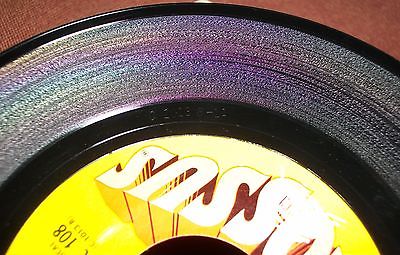
Label: Colossus ?– C 108
Format: Vinyl, 7", 45 RPM, Single
Country: US
Released: 1969
Genre: Rock
Style: Psychedelic Rock
Tracklist
A Venus 3:05
B Hot Sand 2:39
Credits
Written-By – R. v. Leeuwen*
Barcode and Other Identifiers
Ethched Matrix / Runout (A-Side): C-1012 A
Etched Matrix / Runout (B-Side): C-1013 B
Rights Society: BMI
PLAYED & TESTED
RECORD IS NM+
YOUR SATISFACTION IS GUARANTEED
BOX 2
----------------------------------------------
FYI
Shocking Blue was a Dutch rock band from The Hague, the Netherlands, formed in 1967. Their biggest hit, "Venus", went to No. 1 on the Billboard Hot 100 in February 1970, and the band had sold 13.5 million discs by 1973, but the group disbanded in 1974.
Shocking Blue was founded in 1967 by Robbie van Leeuwen. The group had a minor hit in 1968 with "Lucy Brown is Back in Town". After Mariska Veres took over the vocals, the group charted a world-wide hit with the song "Venus", which peaked at No. 3 in the Netherlands in 1969. The song reached No. 1 on the U.S. Billboard Hot 100 in February 1970. It subsequently sold 350,000 copies in Germany, and topped the U.S. chart for three weeks, the first song from the Netherlands to do so. It sold over one million copies there by January 1970, and received a gold record awarded by the Recording Industry Association of America. Global sales exceeded five million copies. The song was based on "The Banjo Song" (1963) by The Big 3.
Other hits include "Send Me a Postcard" in 1968/69 and "Long and Lonesome Road" (often mistakenly named as "Long Lonesome Road") in 1969. Shocking Blue's songs also received quite a large amount of radio airplay on Dutch channels.
"Venus" was followed by "Mighty Joe" (flip-side "Wild Wind") in 1969 and "Never Marry a Railroad Man" (flip-side "Roll Engine Roll") in 1970, which both sold over a million records. Later songs – including "Hello Darkness" (1970), "Shocking You", "Blossom Lady" and "Out of Sight, Out of Mind" (1971), "Inkpot", "Rock in the Sea" and "Eve and the Apple" (1972) and "Oh Lord" (1973) were successful in Europe, Latin America and Asia, but failed to chart in the U.S..
In 1974 Mariska Veres left the group to start a solo career until 1982. Her singles "Take Me High" (1975) and "Lovin' You" (1976) were mainly popular in the Netherlands, Belgium and Germany. Other known singles were "Tell It Like It Is" (1975), Dusty Springfield's "Little By Little" (1976), and "Too Young" (1978). Most of these songs today are rare.
Shocking Blue made a comeback in 1979, and recorded "Louise" as their first single since their breakup back in 1974. However, the song was never released for unknown reasons. They did however, perform live with their earliest songs such as "Venus" and "Never Marry a Railroad Man" in 1980. They made another comeback in 1984, and later recorded "Jury and the Judge" with "I Am Hanging on to Love" on B-side, and yet another unreleased song "Time Is a Jetplane" in 1986.
Bananarama covered "Venus" in 1986, hitting number one in the US and the UK Top 10 (#8). Nirvana covered the Shocking Blue song "Love Buzz" as their debut single in 1988, and it also appeared on their 1989 album Bleach.
Mariska Veres died of cancer on 2 December 2006.
Psychedelic rock is a style of rock music that is inspired or influenced by psychedelic culture and attempts to replicate and enhance the mind-altering experiences of psychedelic drugs. It often uses new recording techniques and effects and sometimes draws on sources such as the ragas and drones of Indian music.
It was pioneered by musicians including the Beatles, the Byrds, and the Yardbirds, emerging as a genre during the mid-1960s among folk rock and blues rock bands in the United Kingdom and United States, such as Grateful Dead, Jefferson Airplane, the Jimi Hendrix Experience, Cream, the Doors and Pink Floyd. It reached a peak in between 1967 and 1969 with the Summer of Love and Woodstock Rock Festival, respectively, becoming an international musical movement and associated with a widespread counterculture, before beginning a decline as changing attitudes, the loss of some key individuals and a back-to-basics movement, led surviving performers to move into new musical areas.
Psychedelic rock influenced the creation of psychedelic pop and psychedelic soul. It also bridged the transition from early blues- and folk music-based rock to progressive rock, glam rock, hard rock and as a result influenced the development of subgenres such as heavy metal. Since the late 1970s it has been revived in various forms of neo-psychedelia.
A sitar, much used on early records of the genre.
As a musical style, psychedelic rock attempted to replicate the effects of and enhance the mind-altering experiences of hallucinogenic drugs, incorporating new electronic and recording effects, extended solos, and improvisation, and it was particularly influenced by eastern mysticism, reflected in use of exotic instrumentation, particularly from Indian music or the incorporation of elements of eastern music. Major features include:
electric guitars, often used with feedback, wah wah and fuzzboxes;
elaborate studio effects, such as backwards tapes, panning, phasing, long delay loops, and extreme reverb;
non-Western instruments, specifically those originally used in Indian classical music such as the sitar and tabla ;
a strong keyboard presence, especially organs, harpsichords, or the Mellotron (an early tape-driven 'sampler');
extended instrumental solos or jams;
complex song structures, key and time signature changes, modal melodies and drones;
electronic instruments such as synthesizers and the theremin;
lyrics that made direct or indirect reference to drugs, as in Jefferson Airplane's "White Rabbit" or Jimi Hendrix's "Purple Haze";
surreal, whimsical, esoterically or literary-inspired, lyrics.
The term psychedelic was first coined in 1957 by psychiatrist Humphry Osmond as an alternative descriptor for hallucinogenic drugs in the context of psychedelic psychotherapy. The first musical use of the term psychedelic is thought to have been by the New York-based folk group The Holy Modal Rounders on their version of Lead Belly's "Hesitation Blues" in 1964. The first group to advertise themselves as psychedelic rock were the 13th Floor Elevators from Texas, at the end of 1965. The term was first used in print in the Austin American Statesman in an article about the band titled "Unique Elevators shine with psychedelic rock", dated 10 February 1966, and theirs was the first album to use the term as part of its title, in The Psychedelic Sounds of the 13th Floor Elevators, released in August that year.
As the countercultural scene developed in San Francisco the terms acid rock and psychedelic rock were used in 1966 to describe the new drug-influenced music and were being widely used by 1967. The terms psychedelic rock and acid rock are often used interchangeably, but some commentators have distinguished the former, which generally evoked the effects of psychedelic drugs, and acid rock, which can be seen as a more extreme subgenre that focused more directly on LSD, was often louder, made greater use of distortion and often consisted of long, improvised jams.
From the second half of the 1950s, Beat Generation writers like William Burroughs, Jack Kerouac and Allen Ginsberg wrote about and took drugs, including cannabis and Benzedrine, raising awareness and helping to popularise their use. In the same period Lysergic acid diethylamide, better known as LSD, or "acid" (at the time a legal drug), began to be used in the US and UK as an experimental treatment, initially promoted as a potential cure for mental illness.
In the early 1960s the use of LSD and other hallucinogens was advocated by proponents of the new "consciousness expansion", such as Timothy Leary, Alan Watts, Aldous Huxley and Arthur Koestler, their writings profoundly influenced the thinking of the new generation of youth. There had long been a culture of drug use among jazz and blues musicians, and, in the early 1960s, use of drugs (including cannabis, peyote, mescaline and LSD) had begun to grow among folk and rock musicians, who also began to include drug references in their songs.
Two of the most successful and influential acts of the era, Bob Dylan and the Beatles, were among the first to experiment with such references. Dylan's song "Subterranean Homesick Blues" (1965), which may have taken its title from a Kerouac novel, included the line, "Johnny's in the basement, mixing up the medicine", and his "Mr. Tambourine Man" (1965) requested "Take me on a trip upon your magic swirling ship". Whether this was intended as a drug reference was unclear, but the line would enter rock music when the song was a hit for the Byrds later in the year. Dylan indicated that he had smoked cannabis, but has denied using hard drugs. Nevertheless, his lyrics would continue to contain apparent drug references.
(STOCK PICTURE FOR DISPLAY ONLY)
---------------------------
Thanks for choosing this auction. You may email for alternate payment arrangements. We combine shipping. Please pay promptly after the auction. The item will be shipped upon receipt of funds. Remember if you are outside the continental US there will be additional shipping costs. Also, INTERNATIONAL CUSTOMS is the international buyers obligation and must be aware of their own customs laws. We cannot be responsible for seized or quarantine purchases. If your shipping costs seems high, it is because we ensure that your purchase is well packed, quickly delivered, and insured to arrive safe and sound. WE ARE GOING GREEN, SO WE DO SOMETIMES USE CLEAN RECYCLED MATERIALS TO SHIP. DO NOT BE TOO PERSNICKETY.
Please leave feedback when you have received the item and are satisfied. Please respond when you have received the item * If you were pleased with this transaction, please respond with all 5 stars! If you are not pleased, let us know via e-mail. Our goal is for 5-star service. We want you to be a satisfied, return customer.
Please express any concerns or questions. More pictures are available upon request. The winning bid will incur the cost of S/H INSURED FEDEX OR USPS. See rate calculator or email FOR ESTIMATE. International Bidders are Welcome but be mindful if your country is excluded from safe shipping. Additional costs will be applied to postage outside the continental US. It is advisable to contact us first as this cost can inflate quickly.
Thanks for perusing THIS and ALL our auctions.
Please Check out our other items!
WE like the curious and odd.
Buy, bye.
Track Page Views With
Auctiva's FREE Counter
price rating