1958 RADIO Show JIM REEVES HOUR Anita Kerr Steinway Hall WABC ACETATE 2x33 rpm
$
300


Favourite Auctions
To save auctions to your favourites, please login
If you don't have an account, please register
Description
A series of great SPOKEN WORD Records from Movies, Vaudeville, Stage and Humor on 78 rpm Victrola Records
Click this link for more recitations and Spoken Word Records in my other listings!
Click this link for more great Personality and Humor Records in my other listings!
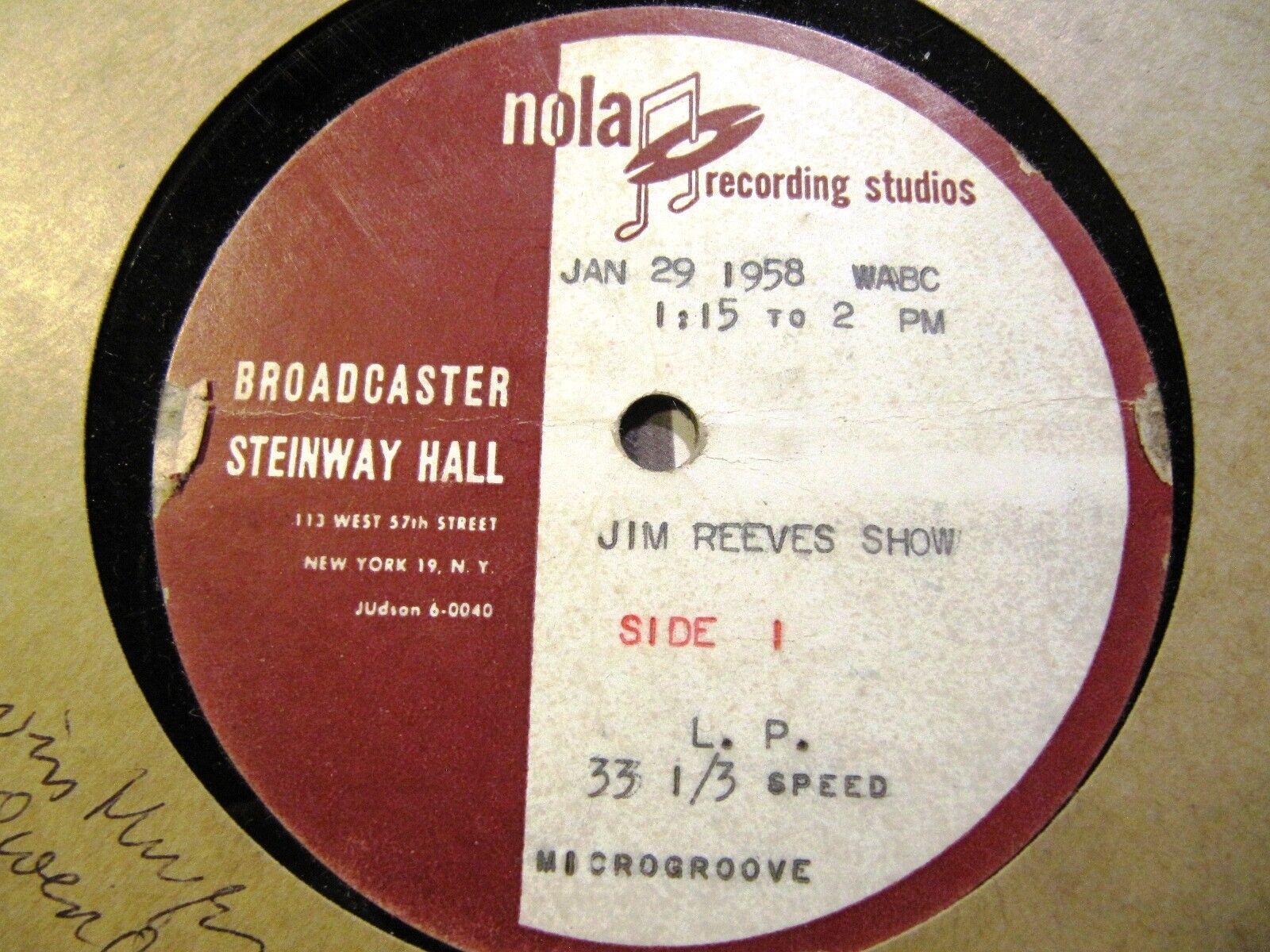
Live from Music City COMPLETE recording from of one of the last "The Jim Reeves Show"
Jan 29 1958 1:15-2 PM on WABC 777 New York
by Broadcaster Steinway Hall - Nola Recording Studio
Featured performers include:
David Todd
Anita Kerr Quartett
Buddy Hall
Dolores Watson
Owen Bradley Orch
Dianne Earhart
Marvin Hughes
Advertisers include
Live American Radio Contest - Prize 7 days Buenos Aires Argentine Airlines
Breeze Cannon Kitchen Towels
Pure Natural Barnette Vanilla Flavor
Weatherscope
Knox Gelatin - Overweight reducing plan
Dove Soap
Live from Music City COMPLETE recording from of one of the last "The Jim Reeves Show"
2x12" Aluminum core Acetate records 3 sides, 33 rpm microgroove. No crazing, flaking dents or other damage
EXCELLENT faint scuffs, first record has a slight thump first 7mm may need a penny on tonearm.
Plays very quiet
A SUPERB COPY
In the latter half of 1957 and early '58, Jim did a daily, one-hour radio program called the "Jim Reeves Show." It aired on the ABN network (forerunner of ABC) and was carried coast-to-coast. It was done live from the WSM studios in Nashville. Featured were the infamous Owen Bradley and his orchestra, the Anita Kerr singers, soloists Dolores Watson and Buddy Hall, along with David Cobb as the announcer. Aside from being an incredible singer, Jim's other great talent was for the spoken word. He was a "natural," as Anita Kerr has pointed out, able to read a script so convincingly that it sounded informal and ad-libbed. Yet it was all scripted -- down to the smallest detail.
The show had a pop flavor to it, and Jim did many songs that even his die-hard fans have not heard him perform -- unless they were listening to his network show on the days it aired! Though transcription copies of the show were made, Mary Reeves only had a few of them, and just two or three bootleg versions have ever ended up in the hands of collectors. The show she did rave about -- and had planned to eventually release -- was a Christmas show in which Jim sang Bing Crosby's "White Christmas," among other tunes. He also did "Rudolph the Red-Nosed Reindeer." This was a song he never recorded at RCA, yet the radio version has turned up even on the internet last holiday season.
In any event, the show was wildly popular, but tied Reeves down and prevented him from touring. When the network decided it would be cheaper to play recorded music rather than featuring a live performer -- even one as great as Jim Reeves -- the show ended in early 1958.
James Travis Reeves (August 20, 1923 – July 31, 1964) was an American country and popular music singer and songwriter. With records charting from the 1950s to the 1980s, he became well known as a practitioner of the Nashville Sound. Known as "Gentleman Jim", his songs continued to chart for years after his death in a plane crash. He is a member of both the Country Music and Texas Country Music Halls of Fame.
Biography
Early life and education
Reeves was born at home in Galloway, Texas, a small rural community near Carthage. He was the youngest of eight children born to Thomas Middleton Reeves (1882-1924) and Mary Beulah Adams Reeves (1884-1980). He was known as Travis during his childhood years. Winning an athletic scholarship to the University of Texas, he enrolled to study speech and drama but quit after only six weeks to work in the shipyards in Houston. Soon he resumed baseball, playing in the semi-professional leagues before contracting with the St. Louis Cardinals "farm" team during 1944 as a right-handed pitcher. He played for the minor leagues for three years before severing his sciatic nerve while pitching, which ended his athletic career.[1]
Early career
Reeves' initial efforts to pursue a baseball career were sporadic, possibly due to his uncertainty as to whether he would be drafted into the military as World War II enveloped the United States. On March 9, 1943, he reported to the Army Induction Center in Tyler, Texas for his preliminary physical examination. However, he failed the exam (probably due to a heart irregularity), and on 4 August 1943 an official letter declared his 4-F draft status.[2] Reeves began to work as a radio announcer and sang live between songs. During the late 1940s, he was contracted with a couple of small Texas-based recording companies, but without success. Reeves at this point was influenced by early country and western swing artists including Jimmie Rodgers and Moon Mullican, as well as popular singers Bing Crosby, Eddy Arnold and Frank Sinatra. In the late 1940s, Reeves joined Moon Mullican's band, and as a solo artist, Reeves recorded Mullican-style songs including "Each Beat of my Heart" and "My Heart's Like a Welcome Mat" in the late 1940s and early 1950s.
During these years, Reeves took a job as an announcer for KWKH-AM in Shreveport, Louisiana, then the home of the popular radio program Louisiana Hayride. According to former Hayride master of ceremonies Frank Page, who had introduced Elvis Presley on the program in 1954,[3] singer Sleepy LaBeef was late for a performance, and Reeves was asked to substitute. (Other accounts—including that of Reeves himself, in an interview on the RCA Victor album Yours Sincerely—name Hank Williams as the absentee.)
Initial success in the 1950s
Jim Reeves was a country music singer who had success early on in his career, first with the song "Mexican Joe" in 1953 for Abbott Records.[4] Other hits followed, such as "I Love You" (a duet with Ginny Wright), and "Bimbo" which reached number one on the U.S. country charts in 1954. In addition to those early hits, Reeves recorded many other songs for Fabor Records and Abbott Records. In 1954, Abbott Records released a 45 single with "Bimbo" on side-A which hit number one and featured Little Joe Hunt of the Arkansas Walk of Fame. Jim Reeves and Little Joe Hunt met at the Louisiana Hayride, which was Louisiana's equivalent to Nashville's Grand Ole Opry. After performing at the Hayride in Shreveport, Reeves and Hunt traveled and performed together for several years in the dance halls and clubs of East Texas and rural Arkansas. Reeves became the headliner with Hunt as the backup performer. Due to his growing popularity, Reeves went on to release his first album in November 1955, Jim Reeves Sings (Abbott 5001), which proved to be one of Abbott Records' few album releases. Reeves' star was on the rise because he had already been signed to a 10-year recording contract with RCA Victor by Steve Sholes. Sholes went on to produce some of Reeves' first recordings at RCA Victor. Sholes signed another performer from the Louisiana Hayride that same year (1955), Elvis Presley. Most of the talented performers of the 1950s such as Reeves, Presley, Jerry Lee Lewis, Jim Ed Brown, Maxine Brown, the Wilburn Brothers, and Little Joe Hunt got their start at the Louisiana Hayride. In addition to the Hayride, Jim Reeves joined the Grand Ole Opry, also in 1955.[5] Reeves also made his first appearance on ABC-TV's Ozark Jubilee in 1955. He was such a hit with the fans that he was invited to act as fill-in host from May thru July 1958 on the popular program, Ozark Jubilee.
From his earliest recordings with RCA Victor, Reeves relied on the loud, East Texas style, which was considered standard for country and western performers of that time, but he developed a new style of singing over the course of his career. He said, "One of these days.....I'm gonna sing like I want to sing!" So, he decreased his volume and used the lower registers of his singing voice, with his lips nearly touching the microphone. Amid protests from RCA, but with the endorsement of his producer Chet Atkins, Reeves used this new style in a 1957 recording, a demonstration song of lost love that had originally been intended for a female voice. It was titled "Four Walls", which not only scored number one on the country music charts, but also scored number 11 on the popular music charts, as well. This recording marked his transition from novelty songs to serious country-pop music, and according to one source, "established Reeves as a country balladeer".[4] "Four Walls" and "He'll Have to Go" (1959) defined Reeves' style.[6]
Reeves was instrumental in creating a new style of country music that used violins and lusher background arrangements that soon became known as the Nashville Sound. This new sound was able to cross genres, which made Reeves even more popular as a recording artist.
Reeves became known as a crooner because of his light yet rich baritone voice. Because of his vocal style, he was also considered a talented artist because of his versatility in crossing the music charts. He appealed to audiences that were not necessarily country/western. His catalog of songs such as "Adios Amigo", "Welcome to My World", and "Am I Losing You?" demonstrated this appeal. Many of his Christmas songs have become perennial favorites, including "C-H-R-I-S-T-M-A-S",[7] "Blue Christmas", and "An Old Christmas Card". Between 1957 and 1958, Reeves was the host of a radio show on the ABC network; this was also when he began shifting from cowboy outfits to sports jackets.[8]
Reeves is also responsible for popularizing many gospel songs, including "We Thank Thee", "Take My Hand, Precious Lord", "Across the Bridge", and "Where We'll Never Grow Old". He was given the nickname Gentleman Jim, an apt description of his character both on stage and off.
price rating