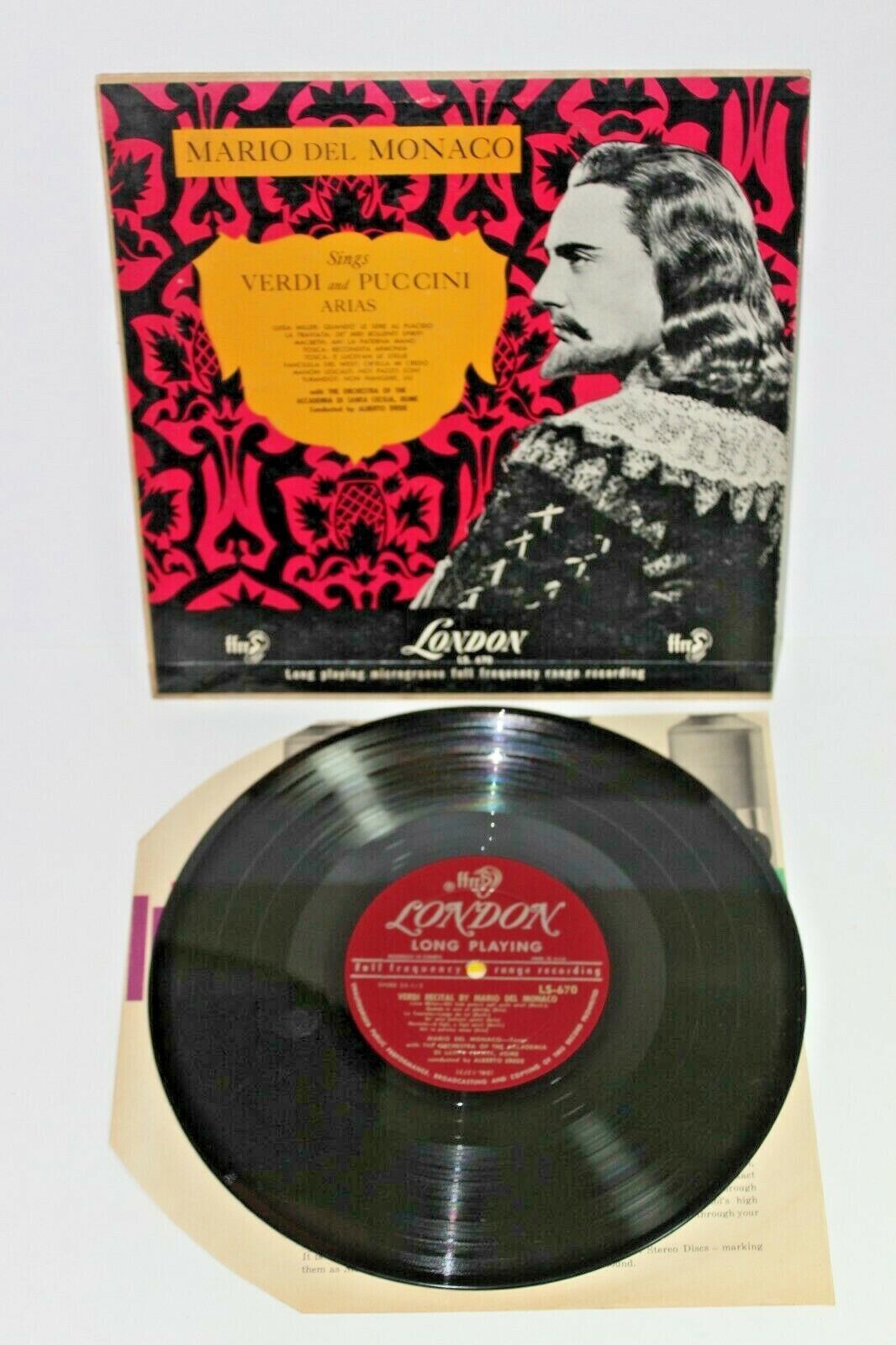
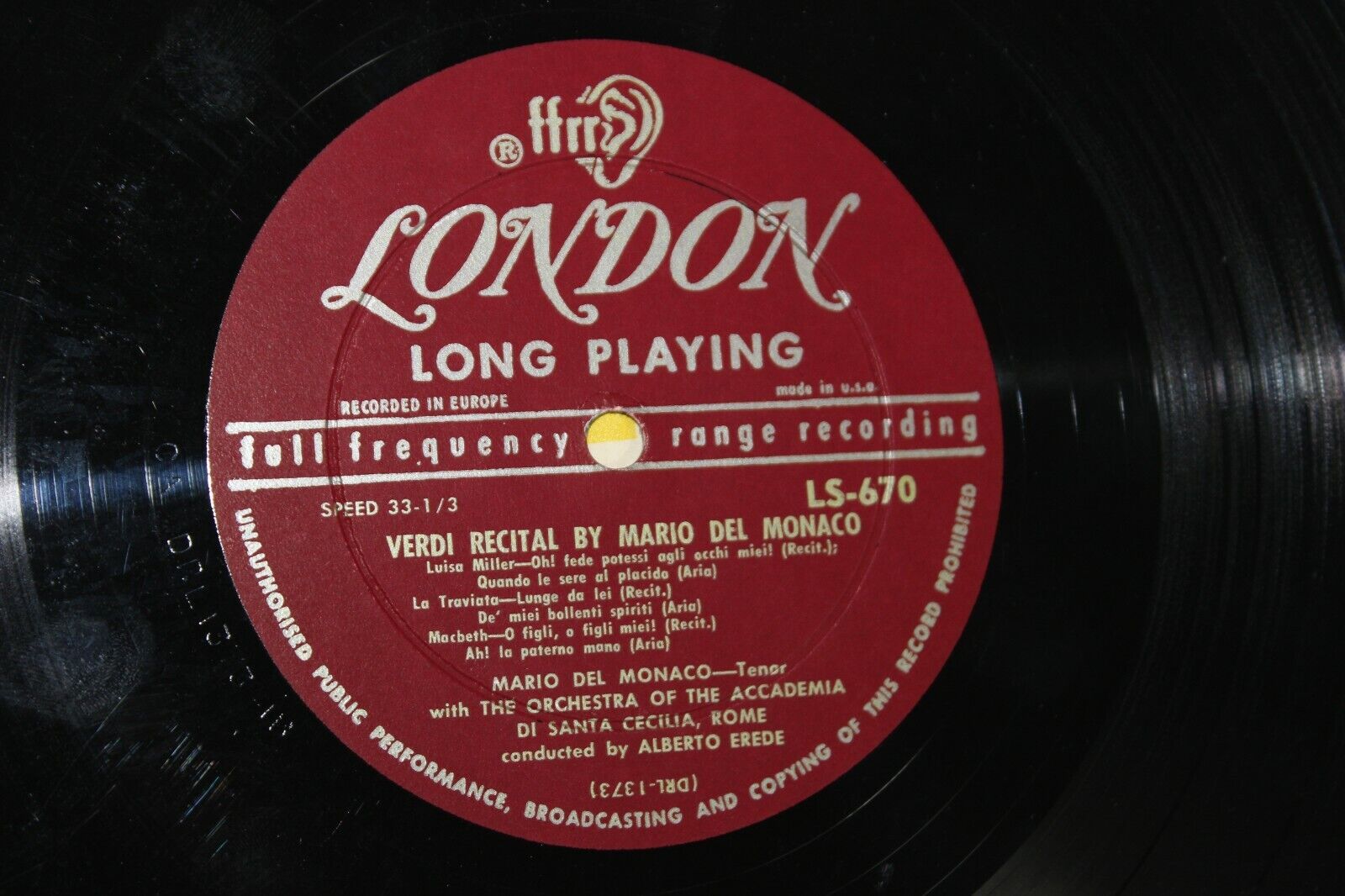
1950s Mario Del Monaco Sings Verdi & Puccini Arias 10" Vinyl 33 RPM Record Album
$
25

Favourite Auctions
To save auctions to your favourites, please login
If you don't have an account, please register
Description
1950s Mario Del Monaco Sings Verdi & Puccini Arias 10" Vinyl 33 RPM Record Album
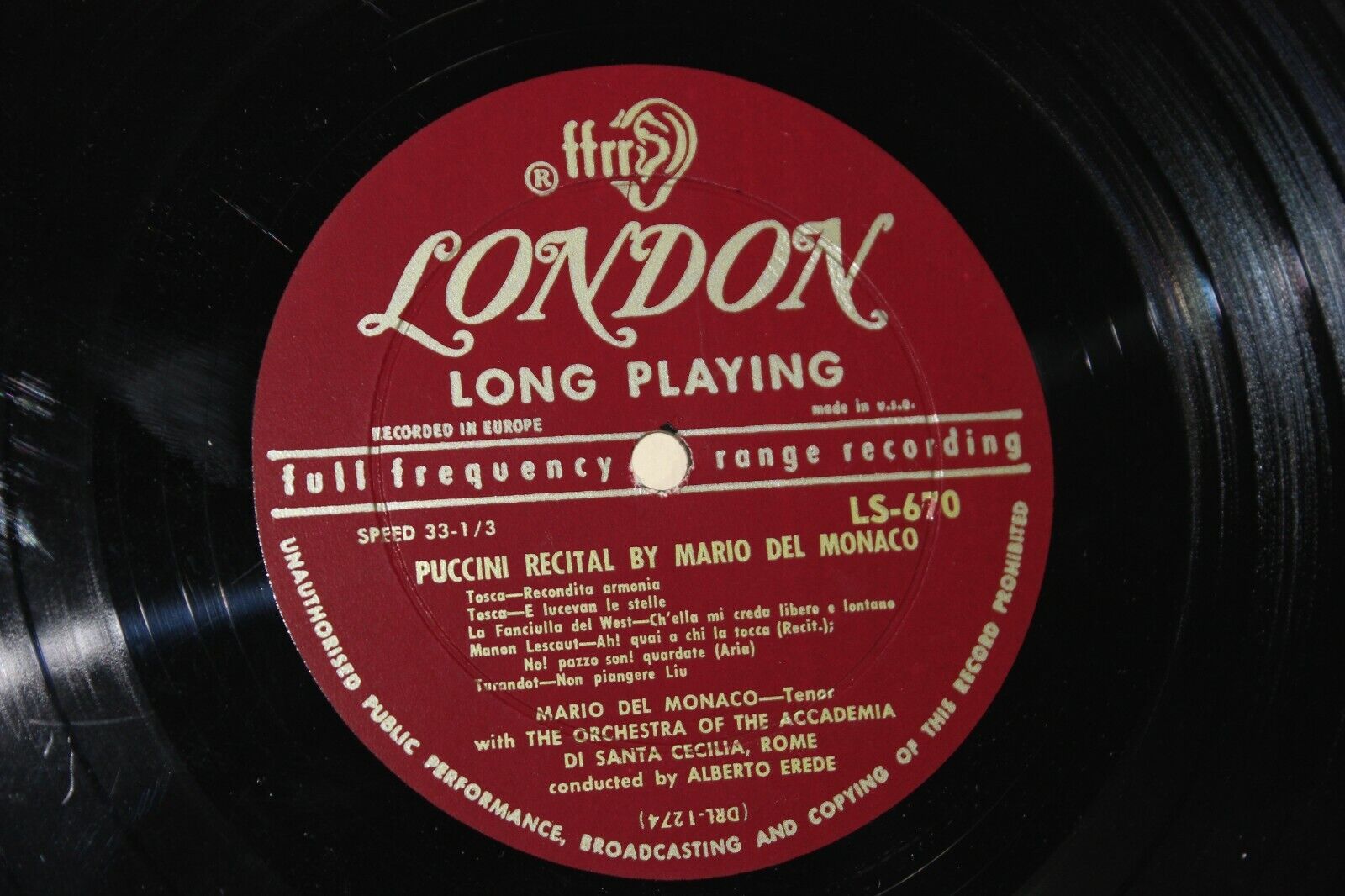
London Records LS-670
MARIO DEL MONACO Sings VERDI and PUCCINI ARIAS LUISA MILLER: QUANDO LE SERE AL PLAC/DO LA TRAVIATA: DE' M/E/ BOLLENTI SPIRIT! MACBETH: AHI LA PATERNA MANO TOSCA: RECONDITA ARMONIA TOSCA: E LUCEVAN LE STELLE FANCIULLA DEL WEST: CH'ELLA Ml CREDO MANON LESCAUT: NO/ PAZZO SON! TURANDOT: NON PIANGERE, LIU with THE ORCHESTRA OF THE ACCADEMIA DI SANTA CECILIA, ROME Conducted by ALBERTO EREDE The three Verdi arias here recorded are taken from operas which date comparative!}' early in the composer’s out- put. To a certain extent all three conform to a set pattern; each has a preliminary recitative and a concluding caden- za, and the accompaniments are extremely simple, merely serving to support the vocal line as unobtrusively as possi- ble. In such circumstances, the quality of the composer’s melodic inspiration is vital, and it is fortunate that Verdi happened to be a supreme melodist as well as one of the most gifted dramatic composers of his time. Luisa Miller, first performed at Naples on Dec. 8, 1849, was an adaptation of Schiller’s famous play Kabale und Liebe. It is an opera of many merits, anticipating in some respects the style of La Traviala, and it certainly deserves more attention from impresarios than it has hitherto re- ceived. The aria here recorded is from the second act. Rodolfo, the son of a Tyrolean count, loves Luisa, the daughter of an old soldier named Miller, but the count has other plans for his son and arrests Miller on the charge of uttering threats against his feudal lord. He is condemned to death and the count only consents to grant a pardon on condition Luisa writes a letter stating that she never loved Rodolfo. She does so, and it is arranged for the letter to fall into her lover’s hands. Rodolfo, when he reads it, bewails Luisa’s supposed treachery in the'solo “Quando le sere al placido”, one of the most beautiful of all Verdi’s tenor mel- odies. The aria was a particular favourite of the compos- er’s distinguished collaborator of later years, Arrigo Boito. La Traviata, a work of far greater fame than Luisa Miller, was a conspicuous failure at its first performance in Venice in 1853. Based on a play of Dumas fils La Dame aux ca- melias, it is likely that the unheroic theme and the contem- porary costumes militated against the opera’s success with the Italian public. The story is set in nineteenth century Paris where Violetta Valery, a demi-mondaine, has attract- ed the youthful Alfredo Germonl. In the first act of the opera he declares his love for her at a supper-parly, and, by the second, the two are living together in a house out- side the French capital. The recitative and aria here re- corded begin Act 2. Alfredo, alone on the stage, sings of his new-found happiness with Violetta. Macbeth received its premiere at Florence in 1847. It was the first of Verdi’s three Shakespeare operas, but where- as Ote.llo and Falstaff were the last and finest fruits of the composer’s genius, Macbeth of necessity conforn^ to the manner and idiom of its period. Nevertheless it has many impressive pages and has been revived with succQgf both in England and on the, continent. The chief musical in- terest of the opera is centered in Macbeth and Lady Mac- beth; the tenors Malcolm and Macduff" are subsidiary characters, but they have some fine music allotted to them, especially when Verdi towards the end of the opera adopts the unusual and rather striking device of making them sing together in unison. Macduff, too, has the sombre and very effective aria here recorded, which comes near the begin- ning of the fourth act. Malcolm is marching against Mac- beth who has usurped the Scottish throne. With him is Macduff, whose wife and children have been slain by the usurper; he laments their loss in the aria “Ah! la paterna mano”. Of the four Puccini operas represented in this recital, Tosca is perhaps the best-known. It .was adapted fro»J a play by Victorien Sardou (1831-1908) and first produced in Rome in 1900. The scene is laid in the same city about a century earlier and the first act takes place in the Church of Sant’ Andrea alia Valle where Mario Cavaradossi, an artist, is painting a picture of St. Mary-Madgalene. The sa- cristan, noticing a resemblance between the lady in the pic- ture and the Marchesa Attavanti who frequently comes to worship at the church, is scandalized, but Cavaradossi, un- concerned, takes out a medallion and, in a splendid solilo- quy “Recondita armonia”, contrasts the features of the Mary Magdalene with those of his beloved Tosca. In solo versions of this aria, the disapproving mutterings of the sacristan, are usually omitted. Cavaradossi’s second solo is from the last act. He and Tosca have become involved with Baron Scarpia, chief of the Rome police, and Cavaradossi, condemned to face a firing squad, sings “E lucevan le stclle” on the platform of the Castel Sant’ Angelo as he is awaiting execution. He thinks of Tosca and laments that he must die at the. mo- ment when life has become dearest to him. The aria is one of great beauty. It is based on a single melodic theme, introduced by the clarinet and afterwards taken up by the voice con grande sentimento. La Fanciulla de! West is rarely given nowadays. It was written, at the height of Puccini’s fame, as a successor to Madam Butterfly and received its first production in 1910 at the Metropolitan Opera, New York. Puccini had hoped to win the approval of his new public by setting an Ameri- can story.. La Fanciulla del West was adapted from David Belasco’s drama of the Californian gold fever (1849-50), but unfortunately Puccini, who had supplied such convinc- ing musical “atmosphere” for Paris and Japan, was unsuc- cessful in providing it for the “Golden West”, and the work has never really established itself. It contains some charming things, however, of which the little tenor solo re- corded is one. Jack Rance, the hero of the opera and an outlaw, is about, to be hanged by the sheriff and his men, and he begs them, in a melody which only Puccini coidd have written, to hide the manner of his death from his be- loved Minnie and to let her think that he escaped. The opera has a happy ending for Minnie eventually intervenes and saves her lover. Manon Lescaut was Puccini’s first operatic success and dates from 1893. Il was brave of the composer to choose for his libretto the story of the Abbe Prevost’s famous novel which had already been successfully set by Massenet, and he vindicated his selection by producing a score which is deeply-felt and melodious, even if somewhat lacking in Gallic authenticity. Unlike Massenet, Puccini set the final scene of the story in which Manon, condemned to transport-^ ation as an abandoned woman, has been shipped to Ameri- ca. The third act of the opera is set in a square in Havre where the women to be transported are assembled. Ma- non’s lover, the voting Chevalier des Grieux, beseeches the captain of the ship in <a passionate aria to let him accom- pany Manon to America, and his request is granted as the act concludes. Turandot was Puccini’s last opera. He died before com- pleting it aniPthe unfinished work was performed at La Scala, Milan in 1926. -^n ending, based on the composer’s .sketches, wps subsequently added by his ptipil .Alfano. The opera is based on a play by Carlo Gozzi (1720-1806). A Chinese princess, Turaridot, of radiant, overpowering beau- ty, is possessed of a violent hatred of men. Anyone seeking her hand is required to answer three questions of great diffi- culty and to forfeit his Life if he fails to get them right. In the first act of the opera, Prince Calaf, who is wandering in Pekin with his father Timur, an exiled King of Tartar}', and the slave-girl Liu, catches sight of Turandot and is fas- cinated by her. He at once determines to apply for her hand. Timur and Liu attempt to dissuade him but in vain. In the. powerfully moving solo here recorded, he bids Liu not to weep and asks her to look after his father if he does not survive his examination. Robert Boas. MARIO DEL MONACO * This brilliant artist was born in Florence. At an early age his family moved to Pesaro and it was at the Conservatory of this small Italian city that he first studied piano, theory, harmony and the history of music. He made his debut at the age of thirteen! The opera was Massenet's rarely played one-act idyll Narciso and the results of this experience decided the young man's career immediately. » Largely self-iaught in voice production (gramophone records were avidly studied), Del Monaco is nevertheless a truly accom- plished musician and the posessor of a dramatic instinct that is extremely rare in operatic tenors. He served in the Italian army for over six years, singing sporadically, and made his ac- tual professional debut in Milan on January 1st, 1941 in Ma- dama Butterfly. He was engaged by La Scala immediately after the war and was soon appearing at other important operatic centres in Italy. In 1946, news of his great talents brought him engagements at Covent Garden in London and this was followed by appear- ances in Rio de Janeiro and Buenos Aires from whence he went on Io Mexico. He has sung all over Europe and South America. Del Monaco was contracted by the Metropolitan Opera in September 1950, after Rudolf Bing had heard him opqn the San Francisco Opera with Aida. Previous commitments kept him from doing more than one performance (Manon Lescaut on November 27) but he was a sensational success and returned for the 1951-52 season to sing Aida, Trovatore, Cavalleria Rus- ticana, Oiello, Carmen and Lucia di Lacnmermoor! ^Littte pub- licity has been made of the astonishing fact that he is probably very first tenor in Metropolitan Opera history to have sung the extremely lyric role in Lucia and the tremendously dramatic one in Otello during the course of a single season. His repertoire embraces over forty operas qnd on this record we hear the tenor in famous moments fro’m seven of them. Here is a voice to revive all memories of the “Golden Age". Cer- tainly, it is the finest dramatic tenor to be heard anywhere in the world today.
MARIO DEL MONACO SINGS VERDI and PUCCINI ARIAS with THE ORCHESTRA OF THE ACCADEMIA DI SANTA CECILIA, ROME conducted by ALBERTO EREDE
E
price rating