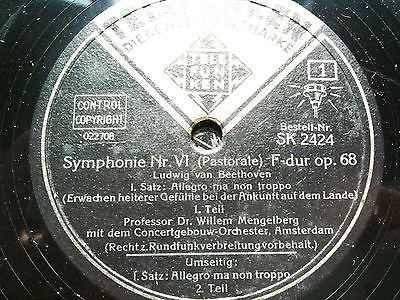
1937 Willem MENGELBERG Beethoven Symp 6 PASTORAL TELEFUNKEN Concertgebouw Or78
$
30


Favourite Auctions
To save auctions to your favourites, please login
If you don't have an account, please register
Description
Please wait for me to send you an invoice. DO NOT USE EBAY CHECKOUT if you want the lowest possible postage.
Welcome to my auctions of great records
This is my FIRST WEEK of 2 weeks of great auctions – I WILL PACK AND BILL YOUR RECORDS after the close on MAY 22.
PLEASE DO NOT PAY before I send you an invoice. It will take me up to 48 hours to pack your records, but this is the ONLY WAY to get you the LOWEST POSTAGE. If you pay before I sent you an invoice, the EBAY system will charge you a HIGHER POSTAGE for shipping.
International shipping: approx postage 1x10"=$25: 1x12"=$36: 10"Album 4 Rec=50$: 12" Album 2 Rec=50$
HOWEVER in most cases I can get you SIGNIFICANT savings by using other services. Pls contact me for a quote.
About 30% less to Canada. Pls ignore international postage displayed in Ebay, rates are too high
Pleas do not use EBAY CHECKOUT, send me an invoice request instead and I will pack your records and bill you promptly.
Late Electric recordings by Willem Mengelberg
from his famous TELEFUNKEN Beethoven CycleSymphony No. 6 in F, Op. 68 "Pastorale" (recorded December 22, 1937).
[78s] Telefunken (Germany)
Concertgebouworkest, Amsterdam
recorded at Concertgebouw, Amsterdam
Performances are unique. There are no others like them. Often from bar to bar there are tempo changes, with frequent use of portamento (sliding from one note to the next) and incredible attention to detail. Often orchestration is altered. "Beethoven, like many other composer, made changements in his scores even after publication, and then he also vos deaf. So vy not the conductor, also, who often knows mooch better than the composer." As in all Mengelberg performances, these interpretations are a remarkable display of orchestral virtuosity.
Oirginal issue 5x 12" 78rpm Telefunken records, no album
Condition: EXCELLENT minus, scuffs, somewhat grainy, rare blisters labels dark, 1 mm nick on 9, tiny open blister on 2
Plays quiet light crackle rare clicks
Willem Mengelberg's first Beethoven recordings were with the predecessor of the New York Philharmonic. In 1922 he made acoustic recordings of Coriolan overture and the first movement of Symphony No. 5 (Biddulph WHL 125/6), and in 1930 electric recordings of Egmont overture and the first and third symphonies (Pearl 9474 and Biddulph WHL 020). Mengelberg's first Beethoven symphony recording with the Concertgebouw was the Allegretto scherzando movement from Symphony No. 8 recorded June 10, 1927 for Columbia/Odeon (the previous year he had recorded overtures to Coriolan and Egmont). Later he would record Leonore 1 and 3 and remake Coriolan and Egmont, along with the "Turkish March" from The Ruins of Athens. From 1937/42 he recorded the symphonies for Telefunken.
Symphony No. 1 in C, Op. 21 (recorded November 8, 1938). Symphony No. 3 in E Flat, Op. 55 "Eroica" (recorded November 11, 1940). Symphony No. 4 in B Flat, Op. 60 (recorded December 1-2, 1938). Symphony No. 5 in C Minor, Op. 67 (recorded April 4, 1937). Symphony No. 6 in F, Op. 68 "Pastorale" (recorded December 22, 1937). Symphony No. 8 in F, Op. 93 (recorded November 9, 1938). Ballet Music The Creatures of Prometheus Op. 43 (recorded November 1, 1942).
Notes point out that Mengelberg also recorded Symphony No. 2 for Telefunken, in April 1941, but it never was issued (one wonders what other treasures might be hidden somewhere?). The three excerpts from Prometheus were issued only on Capitol-Telefunken dubs, part of a series of early-LP issues. Mengelberg recorded Symphony No. 5 twice, first in 1937, again April 15, 1942, the latter issued under the same matrix and catalogue numbers as the earlier version.
Performances are unique. There are no others like them. Often from bar to bar there are tempo changes, with frequent use of portamento (sliding from one note to the next) and incredible attention to detail. Often orchestration is altered. Fine program notes by Dr. Martin Leigh quote Mengelberg's comments about this: "Beethoven, like many other composer, made changements in his scores even after publication, and then he also vos deaf. So vy not the conductor, also, who often knows mooch better than the composer." As in all Mengelberg performances, these interpretations are a remarkable display of orchestral virtuosity, although not totally perfect as pointed out by producer O-T, who has gone to great effort to make these transfers correlate, in regard to 78rpm disc joins, to Mengelberg's live performances.
Joseph Willem Mengelberg (28 March 1871 û 22 March 1951) was a Dutch conductor.
Biography
Mengelberg was born fourth of sixteen children to German born parents in Utrecht, Netherlands. He studied in the Cologne conservatory, including piano and composition. He was chosen as General Music Director of the city of Lucerne Switzerland at age 21.[1] where was conductor of an orchestra and a choir, directed a music school, taught piano lessons and continued to compose.
Mengelberg is highly renowned for his work as the principal conductor of the Concertgebouw Orchestra from 1895 to 1945. In addition, Mengelberg founded the long-standing Mahler tradition of Concertgebouw. In 1902 he met Gustav Mahler and became friends with him. Mengelberg was instrumental in introducing most of Mahler's work to The Netherlands, and Mahler regularly visited The Netherlands to introduce his work to Dutch audiences. In fact, he edited some of his symphonies while in the Netherlands, making them sound better for the acoustics of Concertgebouw. This is perhaps one reason that this concert hall and its orchestra is renowned for its Mahler tradition.
Nevertheless, Mengelberg's importance as a conductor was not only due to his Mahler interpretations. He was also, for example, an exceptionally gifted performer of Richard Strauss; and even today his recordings of Strauss's tone poem Ein Heldenleben which has been dedicated to him and the Concertgebouw Orchestra are widely regarded by critics as among the best ù if not the very best ù of this piece ever made.
One criticism of Mengelberg's influence over Dutch musical life, most clearly articulated by the composer Willem Pijper, was that Mengelberg did not particularly champion Dutch composers during his Concertgebouw tenure, especially after 1920.[2]
Mengelberg with The New York TimesMengelberg was music director of the New York Philharmonic Orchestra from 1922 to 1928. Beginning in January 1926, he shared the podium with Arturo Toscanini; Toscanini biographer Harvey Sachs has documented that Mengelberg and Toscanini clashed over interpretations of music and even rehearsal techniques, creating division among the musicians that eventually resulted in Mengelberg leaving the orchestra. However, the maestro did make a series of recordings with the Philharmonic for both the Victor Talking Machine Company and Brunswick Records, including a 1927 electrical recording of Ein Heldenleben that was later reissued on LP and CD.
The most controversial aspect of Mengelberg's biography centers around his actions and behavior during the years of the Nazi occupation of Holland between 1940 and 1945. Some newspaper articles of the time gave the appearance that he acquiesced to the presence of the Nazi's ideological restrictions on particular composers. Explanations have ranged from political naivet? in general, to a general "blind spot" of criticism of anything German, given his own ancestry. Because of Mengelberg's co-operation with the occupying regime in The Netherlands during World War II, he was banned from conducting in the country by the Dutch government after the war in 1945. He was stripped of his honours and his passport. The original judgment was that Mengelberg would be banned from conducting in the Netherlands for the remainder of his life. Appeals by his attorneys led to a reduction in the sentence to a banning of six years from conducting, retroactively applied to start from 1945. This notwithstanding, he continued to draw a pension from the orchestra until 1949 when cut off by the city council of Amsterdam.[3] Mengelberg retreated in exile to Zuort, Sent, Switzerland, where he remained until his death in 1951, just two months before the expiration of his exile order.
Willem Mengelberg was the uncle of the musicologist and composer Rudolf Mengelberg and of the conductor, composer and critic Karel Mengelberg, who was himself the father of the prominent improvising pianist and composer Misha Mengelberg.
[edit] Recorded Legacy
In addition to his acclaimed recordings of Richard Strauss' Ein Heldenleben, Mengelberg left valuable discs of symphonies by Beethoven and Brahms, not to mention a wildly controversial but gripping reading of Bach's St. Matthew Passion.
His most characteristic performances are marked by a tremendous expressiveness and freedom of tempo, perhaps most remarkable in his recording of Mahler's fourth Symphony but certainly present in the aforementioned St Matthew Passion and other performances as well. These qualities, shared (perhaps to a lesser extent) by only a handful of other conductors of the era of sound recording, such as Wilhelm Furtw?ngler and Leonard Bernstein, make much of his work unusually controversial among classical music listeners; recordings that more mainstream listeners consider unlistenable will be hailed by others as among the greatest recordings ever made.
Many of his recorded performances, including some live concerts in Amsterdam during World War II, have been reissued on LP and CD. While he was known for his recordings of the German repertoire, Capitol Records issued a powerful, nearly high fidelity recording of Cesar Franck's Symphony in D minor, recorded in the 1940s with the Concertgebouw Orchestra.
Due to the Dutch government's six-year ban on Mengelberg's conducting activities, he made no more recordings after 1945. Some of his performances in Amsterdam were recorded on the innovative German tape recorder, the Magnetophon, resulting in unusually high fidelity for the time.
[edit]
More Great Records on sale right now:
http://shop.ebay.com/carsten_sf/m.html
http://shop.ebay.com/carsten_sf/m.html
====
A Quick NOTE ON GRADING AND SHIPPING:
As you can see from my feedback, I try hard to earn your POSITIVE FEEDBACK and FIVE STAR RATINGS.
If for any reason your transaction was NOT SATISFACTORY, pls contact me and I will work something out with you. YOU WILL NEVER HAVE A REASON TO GIVE ME A NEGATIVE RATING or a LOW STAR RATING.
Quick note on grading:
The Grade (Excellent to Fair, I don't give Mint) refers to the WEAR of the record. Any other defects are stated separately
When I listen to a record, I may also give it an aural grade (again E to F), and make a SUBJECTIVE judgment of the pressing quality for hiss and surface noise.
"SUPERQUIET" is basically noiseless, like a vinyl pressing.
"VERY QUIET" is an exceptionally quiet record for a given pressing.
"Quiet" is a record that is a great example without undue noise for a give pressing.
These judgments are SUBJECTIVE and will depend one the styli, phonograph etc. you use on your own equipment.
Pls check my other auctions for more great records and phonograph items:
Multiple item shipping: I am happy to combine items for shipment in one parcel.
If you win multiple items, pls send me an INVOICE REQUEST to calculate the correct postage. Ebay check out will not give you the multiple item discount!
Records will be packed safely between corrugated cardboard in a sturdy box with plenty of padding for safe shipment.
Shipment is usually Media Mail, unless another service is requested. Shipping is at your risk, I will be happy to insure items at your cost.
I charge actual postage plus a small fee for packing materials
As always, I guarantee your satisfaction. If you don't like the item, just return it, and I will refund the full purchase price.
If you are in the San Francisco area, I encourage pick-up in person.
US Domestic Shipping:
Here is a guideline for US Media Mail Shipping:
Prices below are for regular 78 rpm records. Up to about 5 records, I will ship Edison Discs for the same rates. Albums from Album Sets count as 1 record. Above that and for international shipments, it will be actual weight plus a small packing charge (1-3$ depending on size of shipment)
1 record: 4.50 – 5.00$
2 records: 5.75$
5 records: 7.50$
10 records: 9.50$
MANY MORE RECORDS: Don't worry. I safely ship 40 - 50 pounds of records double boxed in moving boxes, and even then Media Mail will probably not exceed 30$.
Please send me a message if you would like to lower your shipping rates!
International Buyers:
All'attenzione degli acquirenti italiani:
ATTENTION TO ITALIAN BUYERS:
Due to rare problems with delivery in ITALY, I will NOT GUARANTEE delivery of parcels sent by US Postal Service First Class and Priority Mail. If you prefer secure delivery, I will be happy to quote you either Registered Mail or shipment by FEDEX
I am very happy to ship records worldwide.
Please use the EBAY shipping cost only as a guideline. My actual charges are usually lower
One record usually ships for 25 – 28$ for 10" 35$ for most 12" records (Less for Canada).
I can get SIGNIFICANTLY LOWER rates from FedEx and the US Postal service for any kind of parcel weight, and will make use of all the cost-saving shipment methods
Pls contact me for a shipping estimate, or send me an invoice request after close of auction.
AND AGAIN -THANK YOU FOR YOUR INTEREST
As you can see from my feedback, I take great care in presenting, grading and shipping your items. I really want you to be happy with the purchase. If you feel that anything is wrong with the item or the shipping, contact me and we will work it out !!!
As always, I would appreciate any suggestions and corrections from you, pls contact me with any question.
Thank you very much, and good luck bidding !!!
price rating