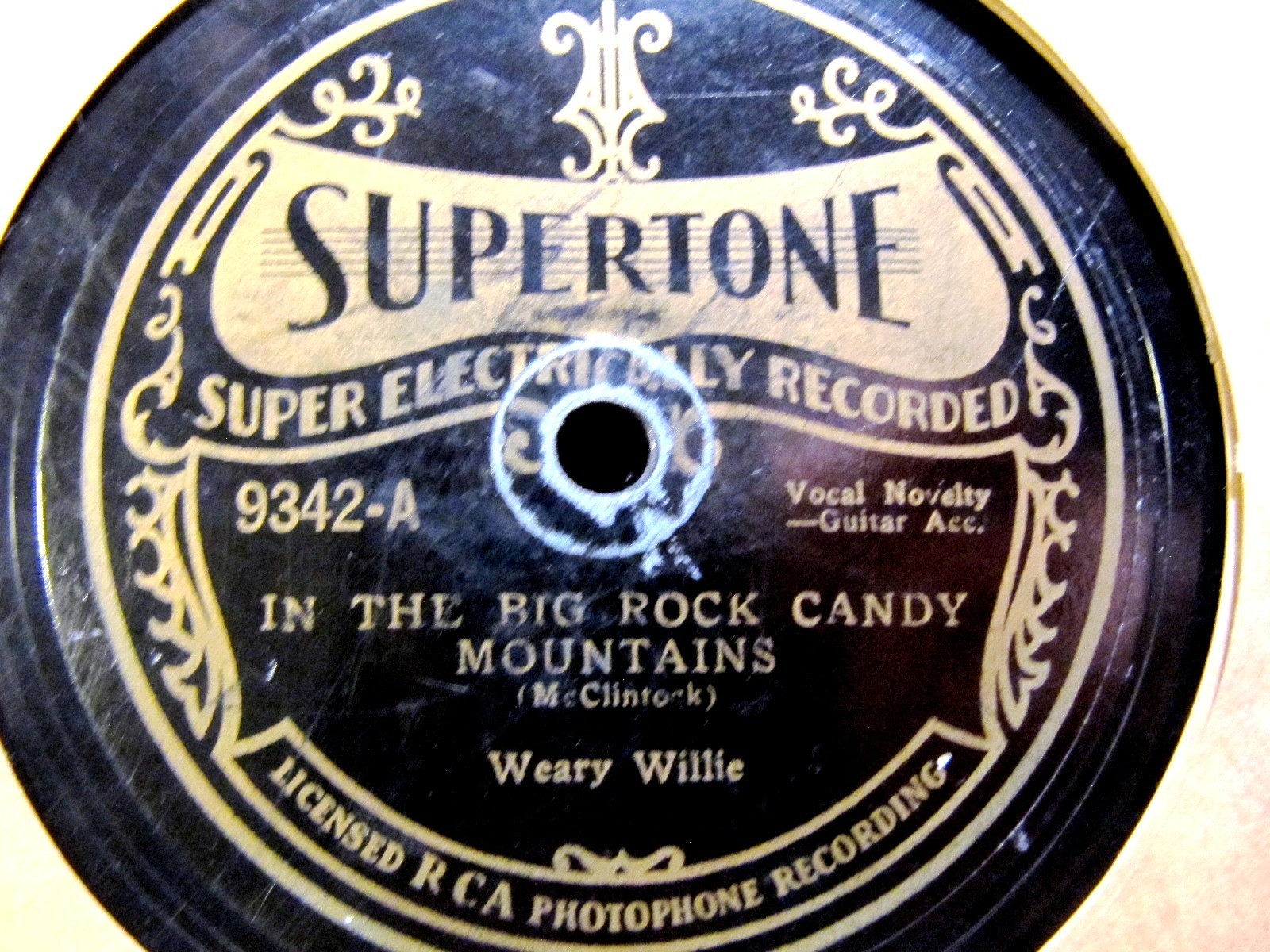
1929 SUPERTONE BIG ROCK CANDY MOUNTAINS Hobo WEARY WILLIE Bum Song Gennett 9342
$
50


Favourite Auctions
To save auctions to your favourites, please login
If you don't have an account, please register
Description
A series of great Southern Folk, Pre-War Country, Hillbilly, Mountain Bands, Polka and Square Dance on 78 rpm Victrola Records
More great SQUARE DANCE, FOLK and POLKA Records in my other listings!
Rare GENNETT Cover Version of Hobo Mac Harry McClintock's famous HOBO Fantasy song of the Land Of Cockaigne
Gennett Electric recording issued on Sear's Supertone by Weary Willie
alias for the Country music vocalist and accordionist Jack Golding
singing and playing guitar
other Aliases
Jack Edwards Jerry Ellis
Both sides recorded 11 December 1928 in Richmond, IN.
Lots of hobo slang in this tune.
Weary Willie – In The Big Rock Candy Mountains / Bum Song No. 2
Label:
Supertone (5) – 9342
Format:
Shellac, 10", 78 RPM
Country:
US
Released:
1929
Genre:
Folk, World, & Country
Style:
Country
A In The Big Rock Candy Mountains
Written-By – Harry McClintock
B Bum Song No. 2
Written-By – Harry McClintock
Marketed By – Sears Roebuck & Co
With guitar accompaniment by unknown artist.
Both sides recorded 11 December 1928 in Richmond, IN.
This coupling originally released on Gennett 6715. Also released on Champion (5) 15646.
Sear's Supertone issue of the Gennett Electrobeam 10" 78 rpm record
Condition:
VERY GOOD, only light greying, rare fine scratches may cause occ ticks, bum song has 2x short stressed grooves, hint of graininess, plays great with some hiss,
GREAT SOUND
"Big Rock Candy Mountain" is a song about a hobo's idea of paradise - a modern version of the medieval concept of Cockaigne, and similar to the fishermans' concept of Fiddler's Green.
History
The song is generally recognized as a turn of the century hobo ballad based on An Invitation to Lubberland, but authorship is also generally attributed to Harry McClintock since earlier written evidence of the song is not known. As a result, the song's copyright status is also in dispute. There are secondhand reports that McClintock attempted to enforce a copyright on the song but lost his lawsuit; in that case the song is in the public domain. Without further verification it must be assumed that the song is copyright by Harry McClintock.
The song was first recorded in 1928 by Harry McClintock, also known as Haywire Mac. It is probably best remembered for its recording by Burl Ives in 1949, but it has been recorded by many artists throughout the world. The most popular version, recorded in 1960 by Dorsey Burnette, reached the Billboard top ten.
Sheet music with a copyright date 1928, by Denton & Haskins Music Pub. Co. Inc., 1595 Broadway, New York, N.Y., identify the author as Billy Mack.
According to the song, anything that a homeless man would fear is rendered harmless. The dogs have rubber teeth, the police have wooden legs, and the jail bars are made of tin.
Before recording the song, McClintock cleaned it up considerably from the version he sang as a street busker in 1897. Originally the song described a child being recruited into hobo life by tales of the "big rock candy mountain". Such recruitment actually occurred, with hobos enchanting children with tales of adventure called ghost stories by other hobos. In proof of his authorship of the song, McClintock published the original words, the last verse of which was:
The punk rolled up his big blue eyesAnd said to the jocker, "Sandy,
I've hiked and hiked and wandered too,
But I ain't seen any candy.
I've hiked and hiked till my feet are sore
And I'll be damned if I hike any more
To be buggered sore like a hobo's whore
In the Big Rock Candy Mountains.
Harry McClintock (October 8, 1882 - April 24, 1957), also known as "Haywire Mac," was an American country music composer and labor organizer, best known for his song Big Rock Candy Mountain (which was in the movie O Brother, Where Art Thou?), as well as his ballad, "Hallelujah, I'm a Bum". He was also credited as being the first person to sing in public "The Preacher and the Slave" , a song by Joe Hill. He was a lifelong member of the Industrial Workers of the World. In the early 1920's he worked and organized union men in the oil fields of west Texas, where he met and recruited writer Jim Thompson who later incorporated him into several short stories using the name "Strawlegs Martin." McClintock was from Knoxville, Tennessee. Having worked as a cowboy himself, McClintock was one of the few "country" singers who had an authentic background to draw from.
Hobo is a term that refers to a subculture of wandering homeless people,[1] particularly those who make a habit of hopping freight trains. The iconic image of a hobo is that of a downtrodden, shabbily-dressed and perhaps drunken male, one that was solidified in American culture during the Great Depression. Hoboes are often depicted carrying a bindle and/or a sign asking for money/work/food.
Hoboes differentiate themselves as travelers who are homeless and willing to do work, whereas a "tramp" travels but will not work and a "bum" does neither.
.price rating