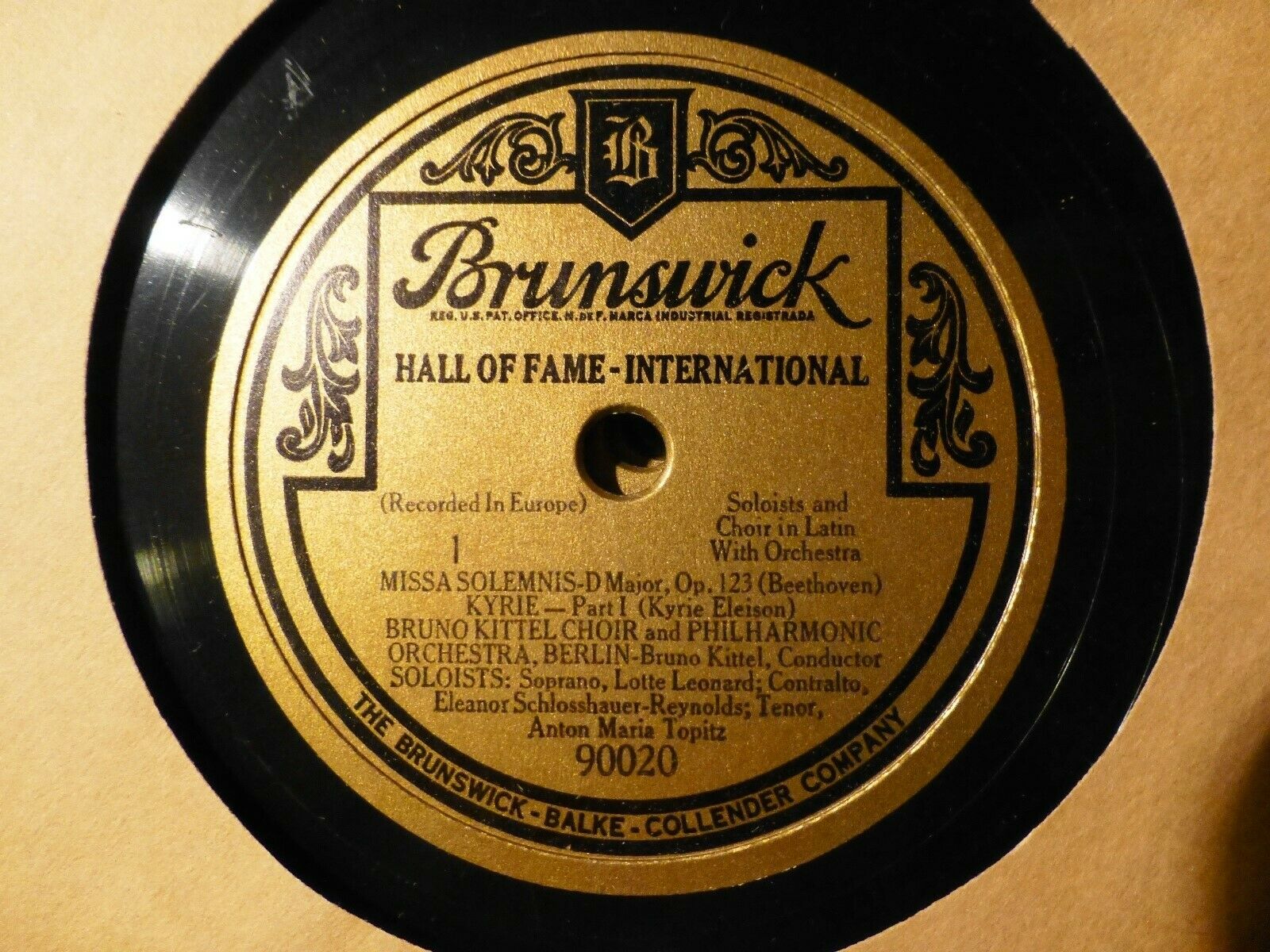
1928 first comp BEETHOVEN MISSA SOLEMNIS Berlin Philharmonic Orch Bruno Kittel
$
30


Favourite Auctions
To save auctions to your favourites, please login
If you don't have an account, please register
Description
Shipping: All items will be packed safely in a sturdy package for safe shipping.
We ship internationally and offer combined shipping for multiple purchases.
Expedited, Priority Mail and FedEx shipping available
Once payment is received, we ship your item on the next business day.
The first complete recording of Beethoven's famous Missa Solemnis
with Berlin Philharmonic Orch under Bruno Kittel and the Bruno Kittel Choir:
Filler Side 22 Chor der St Hedwigskathedrale Berlin: Beethoven Die Ehre Gottes in der Natur
Bruno Kittel – Lotte Leonard / Emmy Land, Elenor Schlosshauer-Reynolds, Anton Maria Topitz / Eugen Transky, Wilhelm Guttmann / Hermann Schey; Bruno-Kittel-Chor, Berlin Philharmonic (1928, Polydor 78s, Japanese DG CDs)
Bruno Kittel – Lotte Leonard / Emmy Land, Elenor Schlosshauer-Reynolds, Anton Maria Topitz / Eugen Transky, Wilhelm Guttmann / Hermann Schey; Bruno-Kittel-Chor, Berlin Philharmonic 1928 Polydor
The first recording of the Missa Solemnis was cut in 1928 by the Berlin Philharmonic led by Bruno Kittel on 21 sides on Polydor 78s, interchanging a total of seven soloists througout the various movements. Kittel was primarily known as a choral director, and the excellence of his choir was acclaimed throughout Europe and preserved in two superb recordings of the Beethoven Ninth by Fried (also 1928) and Furtwangler (1943). As would be expected, the choral singing is rich and forceful (except for a brief blurred Osanna fugetto), and despite dynamic compression Kittel builds and relaxes his climaxes convincingly. Balances mostly are surprisingly good, even though the soloists occasionally are too prominent and a fair amount of overload distortion obscures the instrumental forces in the loudest passages.
Generally, Kittel's leadership is sober and meditative, yielding a very slow overall timing of 85 minutes, although he does differentiate the various sections, even while working them into a evenly-flowing, well-integrated whole. The work reaches its emotional peak with an extraordinarily measured 23 minute Credo, in which the shimmering second section, Et incarnatus est, seems magically suspended in time and effectively sets an aura for the remainder in which drama is subsumed by reverence, somewhat spoiled only by a bland violin solo in the Benedictus and a flaccid orchestral fugue in the Agnus Dei – although the final timpani strokes are chillingly pronounced. Kittle’s deliberate approach set the pace for many others to come.
A reader kindly alerted me to a contemporaneous recording of a June 18, 1927 Barcelona concert to commemorate the centennial of Beethoven's death, given by the Orfeo Catala choral society and issued on a set of 12 Victor 78s (M-29).
Issued on US BRUNSWICK 11x12" 78 rpm Record in two non matching albums
Condition: EXCELLENT, almost pristine, only rare light rubs BUT 9/10 has a tight crack from rim to dead wax.
Plays EXCEPTIONALLY quiet faintest hiss. Albums great some tape on spines
Some may find this immature, sacrilegious, ignorant, smug, or all of the above, but my template for performances of the Missa Solemnis is this: Beethoven poured four years of the peak of his life into creating this astounding work, and any valid performance must radiate an equivalent measure of dedication, sincerity and passion. Undemanding, steady, moderate approaches may be fitting and even preferable in other religious works with a pious mien, but not here. As Denis Stevens observed: “the Missa’s strength derives from the feeling of massive strain and tension, and if this is removed the whole point of the work disappears.” In a reversal of the old adage about not judging a book by its cover, the graphics and liner notes that accompany Missa Solemnis recordings by many famous artists seem more imbued with Beethoven’s spirit than their careful, balanced and respectful performances. Among these are the ones led by Jochum (Philips), Davis (Philips), Wand (Nonesuch LP – with the wonderful gatefold cover art shown at right by Roger Hane), Solti (Decca), Giulini (EMI), Ormandy (Sony), Shaw (Telarc) and Karajan (DG).
The following recordings (among those I've heard) convey to me much of the essence of the Missa Solemnis. While precise categories are impossible for great art, I've grouped them into three broad types – those having deep respect for the weighty basic solemnity of the work (stemming from Kittle’s and Koussevitzky's seminal recordings), those stressing its visceral excitement and revolutionary ardor (beginning with Walter's astounding 1948 concert), and those lavishing scrupulous attention to detail (beginning with Toscanini and extending through historically-informed attempts to recreate the sounds of Beethoven's era).
The Missa Solemnis was not Beethoven’s first religious work, although it certainly was the one in which he expressed himself most fully. In 1803 he had written an oratorio, Christus am Ölburg (Christ on the Mount of Olives), published as his Op. 85 after an 1811 revision. Its subject must have had particular personal appeal as a catharsis following the crisis of Beethoven's incurable deafness and resultant depression. Indeed, Martin Cooper notes that it was Beethoven's first completed work after his wrenching and soul-baring Heilingenstadt Testament and that, by focusing on Christ’s agony in the Garden of Gethsemane, Beethoven identified with Christ’s suffering, terror and isolation while still desiring goodness and a love of mankind. Beethoven later claimed to have written Christus in a fortnight amid distractions, and the general consensus is that it is competent but formulaic and barely inspired. Thus Lewis Lockwood cites its “inconsistent quality … which ranges from routine recitatives and reasonably effective arias … to bombastic choral writing.” In any event, Christus clearly shows that Beethoven was not afraid to inject emotion into his religious writing, even if this work was as much a personal statement as a sacred one.Although the Missa Solemnis has now taken its secure place among Beethoven’s supreme masterworks, it exerted little influence on other composers for a simple reason – it was performed so infrequently that few were able to hear it. The expense of assembling and rehearsing a large orchestra, soloists and chorus is often blamed, even though that never hindered the popularity of his equally massive and challenging Ninth Symphony. Rather, the major problem is the extreme difficulty of the score. The July 1882 Musical Times pronounced: “The work is impossible. No human lungs can endure the strain imposed by it.” The choral sopranos, especially, are called upon to sustain loud notes at the very top of their range for lengths that would surpass the stamina of many soloists. Thus beginning at bar 513 of the Gloria they are to hold a forte high A for about five seconds and at measure 21 of the Credo they are to sustain a fortissimo high B-flat for seven. Instrumental issues abound as well. Roger Fiske notes that Beethoven never wrote out separate parts for the bassoons and contrabassoon but just indicated “col bassi” (“[play] with the bass”) – yet these wind instruments cannot play the same long, continuous lines as a bowed string instrument for a half-minute or more without taking a breath.
Thus, for example, the poor contrabassoons are to open the Gloria with 42 fortissimo bars of rapid eighth note figures, and then starting at bar 440 hold a single forte note for 18 measures (about 35 seconds). Not even the tympani are spared – also at the beginning of the Gloria they are assigned sixteenth note figures in clusters of two alternating between each drum that cannot possibly be played at the specified allegro vivace tempo. Arnold Werner-Jensen attributes all this to Beethoven’s refusal to compromise an artistic vision that surpassed the limitations of instruments and musicians of the era (and even today), to which I would add that it is these very same challenges of the work that add a human dimension of transcending our mortal reality in order to strive for idealism, even while requiring us to strain toward a distant, and perhaps unattainable, goal.
More Great Records on sale right now:
https://www.ebay.com/sch/m.html?_ssn=carsten_sf&_from=R40&_nkw=&_sacat=0&_sop=1
http://shop.ebay.com/carsten_sf/m.html
====
A Quick NOTE ON GRADING AND SHIPPING:
As you can see from my feedback, I try hard to earn your POSITIVE FEEDBACK and FIVE STAR RATINGS.
If for any reason your transaction was NOT SATISFACTORY, pls contact me and I will work something out with you. YOU WILL NEVER HAVE A REASON TO GIVE ME A NEGATIVE RATING or a LOW STAR RATING.
Quick note on grading:
The Grade (Excellent to Poor, I don't give Mint) refers to the WEAR of the record. Any other defects are stated separately
When I listen to a record, I may also give it an aural grade (again E to P), and make a SUBJECTIVE judgment of the pressing quality for hiss and surface noise.
"SUPERQUIET" is basically noiseless, like a vinyl pressing.
"VERY QUIET" is an exceptionally quiet record for a given pressing.
"Quiet" is a record that is a great example without undue noise for a give pressing.
These judgments are SUBJECTIVE and will depend one the styli, phonograph etc. you use on your own equipment.
Multiple item shipping: I am happy to combine items for shipment in one parcel.
If you win multiple items, pls send me an INVOICE REQUEST to calculate the correct postage. Ebay check out will not give you the correct multiple item discount!
Records will be packed safely between corrugated cardboard in a sturdy box with plenty of padding for safe shipment.
Shipment is usually Media Mail, unless you request another service. Shipping is at your risk, I will be happy to insure items at your cost.
I charge actual postage plus a small fee for packing materials
As always, I guarantee your satisfaction. If you don't like the item, just return it, and I will refund the full purchase price.
If you are in the San Francisco area, I encourage pick-up in person.
US Domestic Shipping:
Here is a guideline for US Media Mail Shipping:
Prices below are for regular 78 rpm records. Up to about 5 records, I will ship Edison Discs for the same rates. Albums from Album Sets count as 1 record. Above that and for international shipments, it will be actual weight plus a small packing charge (1-3$ depending on size of shipment)
1 record: 4.75 – 5.50$
2 records: 6.50$
5 records: 8.00$
10 records: 12.00$
MANY MORE RECORDS: Don't worry. I safely ship 40 - 50 pounds of records double boxed in moving boxes, and even then Media Mail will probably not exceed 35$.
Please send me a message if you would like to get an estimate for you shipping rates!
I am very happy to ship records worldwide.
Please use the EBAY shipping cost only as a guideline. My actual charges are usually lower
One record usually ships for 25$ for 10" 25-35$ for most 12" records (Less for Canada).
As always, I would appreciate any suggestions and corrections from you, pls contact me with any question.
Thank you very much, and good luck bidding !!!
price rating


![David Bowie - Nothing Has Changed [2LP] 180 Gram, gatefold) 2014/ SS](https://www.popsike.info/php/thumbnail.php?url=https://www.popsike.pics/pix/20160121/381526562943.jpg)