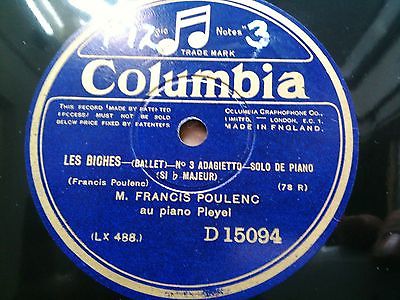
1928 FRANCIS POULENC PIANO Plays LES BICHES Ballet 78
$
33


Favourite Auctions
To save auctions to your favourites, please login
If you don't have an account, please register
Description
Welcome to my auctions of great records
This is my FINAL WEEK of 3 weeks of great auctions – I WILL PACK AND BILL YOUR RECORDS after the close on September 27.
PLEASE DO NOT PAY before I send you an invoice. It will take me up to 48 hours to pack your records, but this is the ONLY WAY to get you the LOWEST POSTAGE. If you pay before I sent you an invoice, the EBAY system will charge you a HIGHER POSTAGE for shipping.
International shipping: approx postage 1x10"=$25: 1x12"=$28: 10"Album 4 Rec=45$: 12" Album 2 Rec=45$
About 30% less to Canada. Pls ignore international postage displayed in Ebay, rates are too high
Please wait for me to send you an invoice. DO NOT USE EBAY CHECKOUT if you want the lowest possible postage.
I am currently selling a series of great Richard Wagner and classic European 78 rpm orchestral recordings on all the great European labels:
FRANCIS POULENC in two selections of his 1923 Ballet les Biches written for Diaghilevs Ballets Russes
Dyaghilev first singled out the young Poulenc as early as 1918, probably on the wise advice of Stravinsky. A letter from Poulenc to the impresario dated 15 November 1921 mentions that he would supply the piano score of Les Biches (The Coquettes) by October 1922, before the orchestral version. In fact, he seems not to have begun work on the composition until July 1922, once he, Dyaghilev and designer Marie Laurencin had agreed on the setting for the ballet, and the orchestration was only done a year later, between July and September 1923. The music for the ballet comprises nine numbers, three of which also feature a chorus. The suite performed here comprises the six piano pieces from the vocal score. Four of them (here Nos. I, II, III and V) seem to have been published separately as early as 1924, under the generic title Morceaux détachés. In 1928, Poulenc recorded two of them (II and III) for Columbia. The length of the Rag-Mazurka and perhaps also the rich complexity of its piano writing may explain why it was not selected for publication, despite its obvious musical attractions.
les Biches No 2 Rondeau/ No 3 Adagietto
12" 78 rpm record COLUMBIA PRESSING
Condition: EXCELLENT close to pristine, plays very veryquiet
Poulenc was born in Paris on 7 January 1899 into a well-known family of industrialists. A Parisian musician, but one with close links to the regions of Burgundy and the Touraine, he followed in the French tradition of Chabrier, his writing brimming with subtlety, humour and genuine emotion, piquant harmonies and a rhythmic lightness. He first encountered Stravinsky’s music in 1910, and between 1914 and 1917 studied piano with Ricardo Viñes. In 1915 he met Milhaud and then, through Viñes, got to know Auric and Satie as well. By 1917 he was a regular at Adrienne Monnier’s bookshop near the Odéon theatre, and there came into contact with the poets Apollinaire, Fargue, Éluard and Aragon. In the same year he also met Radiguet, Honegger, Durey, Germaine Tailleferre and Cocteau, who was to become the promoter of the group known as ‘Les Six’. Between 1921 and 1924 Poulenc studied composition with Koechlin. Unlike Milhaud, with whom he travelled to Rome in 1921 and Central Europe the following year, he was no globe-trotter, although between 1935 and 1959, as pianist with his duo partner baritone Pierre Bernac, he did undertake a number of foreign tours, notably to the United States from 1948 onwards. He never held any official academic or administrative position.
Poulenc’s most accomplished works, despite all his operatic, concerto and chamber successes, are his songs and his sacred and secular choral music, both with and without orchestra. He happily admitted in 1942 to André Schaeffner: “I know very well that I am not an innovative musician like Stravinsky, Debussy or Ravel, but I think there’s a place for new music that is happy to use the chords created by others.”
Poulenc wrote three ballets to commission. On the subject of dance, he said, “For me, dance of course means nothing but classical dance, because I’m a sworn enemy of any kind of rhythmic dance or rhythmic pseudo-dance; I owe my love of classical dance to the years I spent working closely with Dyaghilev.” He himself wrote the scenario for each of his own ballets, explaining his personal approach to choreographic creation as follows: “I write my own libretto, and I cannot imagine creating a ballet in any other way; for the tale of the ballet is born at the same time as the movement of the music.”
It is unusual to hear these ballet scores performed on the piano. It was the nature of the beast that the original form a dance composition took was the “piano score”—the music had to be made available as quickly as possible to enable the choreography to be developed and rehearsals to begin. The contract for the Aubade commission, for example, which came from the Viscount and Viscountess of Noailles, clearly stipulated that the solo piano score had to be delivered by March 1929—two months before the orchestral version.
Poulenc was also well aware that, for him, the piano played an indispensable rôle in the compositional process, and he certainly never concealed the fact that these piano versions came first. They reflect the original creative impulses behind the ballets, and it is therefore debatable whether they should be thought of as “reductions”.
Dyaghilev first singled out the young Poulenc as early as 1918, probably on the wise advice of Stravinsky. A letter from Poulenc to the impresario dated 15 November 1921 mentions that he would supply the piano score of Les Biches (The Coquettes) by October 1922, before the orchestral version. In fact, he seems not to have begun work on the composition until July 1922, once he, Dyaghilev and designer Marie Laurencin had agreed on the setting for the ballet, and the orchestration was only done a year later, between July and September 1923. The music for the ballet comprises nine numbers, three of which also feature a chorus. The suite performed here comprises the six piano pieces from the vocal score. Four of them (here Nos. I, II, III and V) seem to have been published separately as early as 1924, under the generic title Morceaux détachés. In 1928, Poulenc recorded two of them (II and III) for Columbia. The length of the Rag-Mazurka and perhaps also the rich complexity of its piano writing may explain why it was not selected for publication, despite its obvious musical attractions.
Poulenc noted, “There is no plot, as such, for Les Biches. Dyaghilev’s idea was to stage a kind of modernized Sylphides, in other words, a ballet of atmosphere.” The ballet is an updated version of the fêtes galantes, in which “twenty or so beautiful and coquettish women frolic with three athletic fellows in rowing costumes”.
Stylistically, the work draws on French eighteenth-century song (Rondeau), makes exotic reference to ragtime (Rag-Mazurka) and reveals influences both classical (Mozart and Schubert) and modern (Stravinsky and Prokofiev), while the composer told Claude Rostand that the Adagietto was inspired by a variation from Tchaikovsky’s Sleeping Beauty.
More Great Records on sale right now:
http://shop.ebay.com/carsten_sf/m.html
http://shop.ebay.com/carsten_sf/m.html
====
A Quick NOTE ON GRADING AND SHIPPING:
As you can see from my feedback, I try hard to earn your POSITIVE FEEDBACK and FIVE STAR RATINGS.
If for any reason your transaction was NOT SATISFACTORY, pls contact me and I will work something out with you. YOU WILL NEVER HAVE A REASON TO GIVE ME A NEGATIVE RATING or a LOW STAR RATING.
Quick note on grading:
The Grade (Excellent to Fair, I don't give Mint) refers to the WEAR of the record. Any other defects are stated separately
When I listen to a record, I may also give it an aural grade (again E to F), and make a SUBJECTIVE judgment of the pressing quality for hiss and surface noise.
"SUPERQUIET" is basically noiseless, like a vinyl pressing.
"VERY QUIET" is an exceptionally quiet record for a given pressing.
"Quiet" is a record that is a great example without undue noise for a give pressing.
These judgments are SUBJECTIVE and will depend one the styli, phonograph etc. you use on your own equipment.
Pls check my other auctions for more great records and phonograph items:
Multiple item shipping: I am happy to combine items for shipment in one parcel.
If you win multiple items, pls send me an INVOICE REQUEST to calculate the correct postage. Ebay check out will not give you the multiple item discount!
Records will be packed safely between corrugated cardboard in a sturdy box with plenty of padding for safe shipment.
Shipment is usually Media Mail, unless another service is requested. Shipping is at your risk, I will be happy to insure items at your cost.
I charge actual postage plus a small fee for packing materials
As always, I guarantee your satisfaction. If you don't like the item, just return it, and I will refund the full purchase price.
If you are in the San Francisco area, I encourage pick-up in person.
US Domestic Shipping:
Here is a guideline for US Media Mail Shipping:
Prices below are for regular 78 rpm records. Up to about 5 records, I will ship Edison Discs for the same rates. Albums from Album Sets count as 1 record. Above that and for international shipments, it will be actual weight plus a small packing charge (1-3$ depending on size of shipment)
1 record: 4.50 – 5.00$
2 records: 5.75$
5 records: 7.50$
10 records: 9.50$
MANY MORE RECORDS: Don't worry. I safely ship 40 - 50 pounds of records double boxed in moving boxes, and even then Media Mail will probably not exceed 30$.
Please send me a message if you would like to lower your shipping rates!
International Buyers:
All'attenzione degli acquirenti italiani:
ATTENTION TO ITALIAN BUYERS:
Due to rare problems with delivery in ITALY, I will NOT GUARANTEE delivery of parcels sent by US Postal Service First Class and Priority Mail. If you prefer secure delivery, I will be happy to quote you either Registered Mail or shipment by FEDEX
I am very happy to ship records worldwide.
Please use the EBAY shipping cost only as a guideline. My actual charges are usually lower
One record usually ships for 25 – 28$ (Less for Canada).
I can get competitive rates from FedEx and the US Postal service for any kind of parcel weight, and will make use of all the cost-saving shipment methods
Pls contact me for a shipping estimate, or send me an invoice request after close of auction.
AND AGAIN -THANK YOU FOR YOUR INTEREST
As you can see from my feedback, I take great care in presenting, grading and shipping your items. I really want you to be happy with the purchase. If you feel that anything is wrong with the item or the shipping, contact me and we will work it out !!!
As always, I would appreciate any suggestions and corrections from you, pls contact me with any question.
Thank you very much, and good luck bidding !!!
price rating