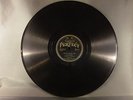
1918 PROHIBITION Alcoholic BLUES WILBUR SWEATMAN Org JAZZ BAND Kansas City A2769
$
25


Favourite Auctions
To save auctions to your favourites, please login
If you don't have an account, please register
Description
A series of great JAZZ Records from early Ragtime to Beb-Bop on 78 rpm Victrola Records
More great Jazz and Vocal Records in my other listings!
FIRST BLACK Jazz Band to record: Wilbur Sweatman's Original Jazz Band :
Louisiana Five Jazz Orchestra performing The Alcoholic Blues / Wilbur Sweatman's Original Jazz Band - Kansas City Blues
Kansas City blues Fox trot
Euday L. Bowman (composer)
Wilbur Sweatman's Original Jazz Band (Musical group)
Wilbur C. S. Sweatman (leader)
3/22/1919 New York, New York Columbia A2768
The alcoholic blues Dance music : Fox trot
Minnie ; Oh lawdy ; Victory ball
Albert Von Tilzer (composer) "The alcoholic blues."
Sidney Lanfield (composer) "Victory ball."
Billy Frisch (composer) "Minnie."
Henry Creamer (songwriter) "Oh lawdy."
Turner Layton (songwriter) "Oh lawdy."
Louisiana Five (Musical group)
6/23/1919 New York, New York Columbia A2768
Louisiana Five, in the famous Prohibition era story about a WWI Veteran: Alcoholic Blues
Please see top of the page for condition
I love my country, 'deed I do
But oh, that war has made me blue
I like fightin', that's my name
But fightin' is the least about the fightin' game
When Mister Hoover said to cut my dinner down
I never even hesitate, I never frown
I cut my sugar, I cut my coal
But now they dug deep in my soul
I've got the blues, I've got the blues
I've got the alcoholic blues
No more beer, my heart to cheer
Goodbye whiskey, you used to make me frisky
So long highball, so long gin
Oh, tell me when you comin' back agin
Louisiana Five
Profile: Early jazz group, formed in 1918 by drummer Anton Lada. The group partook in 18 recordings sessions (mostly for Emerson), which produced more than 50 tracks. The group "achieved little influence before disbanding in 1920". (The New Grove dictionary of jazz, 1988) Aliases:Frisco FiveMembers:Alcide Nunez, Anton Lada, Charles Panelli, Joe Cawley, Karl Berger (2)
Wilbur Sweatman's Original Jazz Band
Sweatman started out playing violin, then took up clarinet instead. He toured with circus bands in the late 1890s, and developed a famous act of playing three clarinets at once. He spent time playing with the bands of W.C. Handy and Mahara's Minstrels. He led a dance band in Minneapolis, Minnesota in 1902, where he made his first recordings on (now lost) phonograph cylinders that year or the following one. He wrote a number of rags, Down Home Rag being the most commercially successful. Sweatman moved to New York in 1913, where he became close friends with Scott Joplin, and Joplin named Sweatman as executor of his estate in his will. Sweatman enjoyed popularity with both White and Black audiences in New York, and started issuing recordings in 1916 for Emerson Records, then for PathT.
After the commercial success of the Original Dixieland Jass Band the following year, Sweatman changed the sound and instrumentation of his band along the line of the early New Orleans jazz bands such as the Original Creole Orchestra and the Original Dixieland Jass Band. Sweatman was the first African American to make recordings labeled as "Jass" and "Jazz". (Since Sweatman can be heard making melodic variations even in his 1916 recordings, it might be argued that Sweatman recorded an archaic type of jazz earlier than the Original Dixieland band.) Sweatman's was the leading jazz band for Columbia Records until his popularity was surpassed by that of Ted Lewis.
Wilbur C. Sweatman was one of the first African-Americans to record Jazz. His first Jazz recordings were made less than two months after The Original Dixieland Jazz Band's "Livery Stable Blues" which is generally considered to be the first Jazz recording. The recordings on this list, other than the Darktown Strutters Ball and Goodbye Alexander are variously labelled as by Wilbur C. Sweatman's Jazz Orchestra/Original Jass Band, Original Jazz Band/Jazz Band, sometimes omitting the middle initial. Copies are known to exist where the band name varies from one side to the other, and sometimes on the same titles from one record to another. The Little Wonder records were released simply as Jazz Band but have been attributed to Sweatman.
price rating