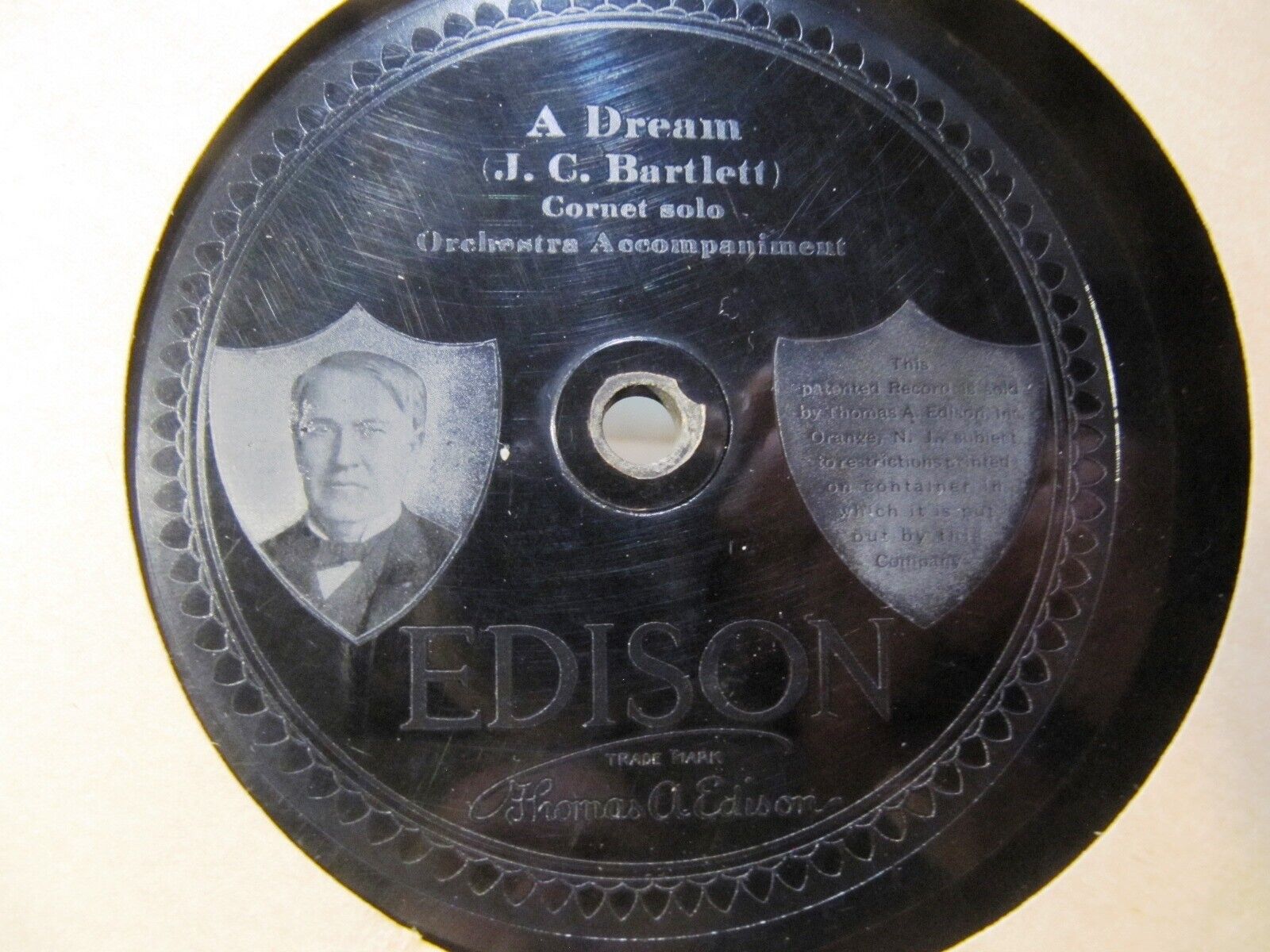
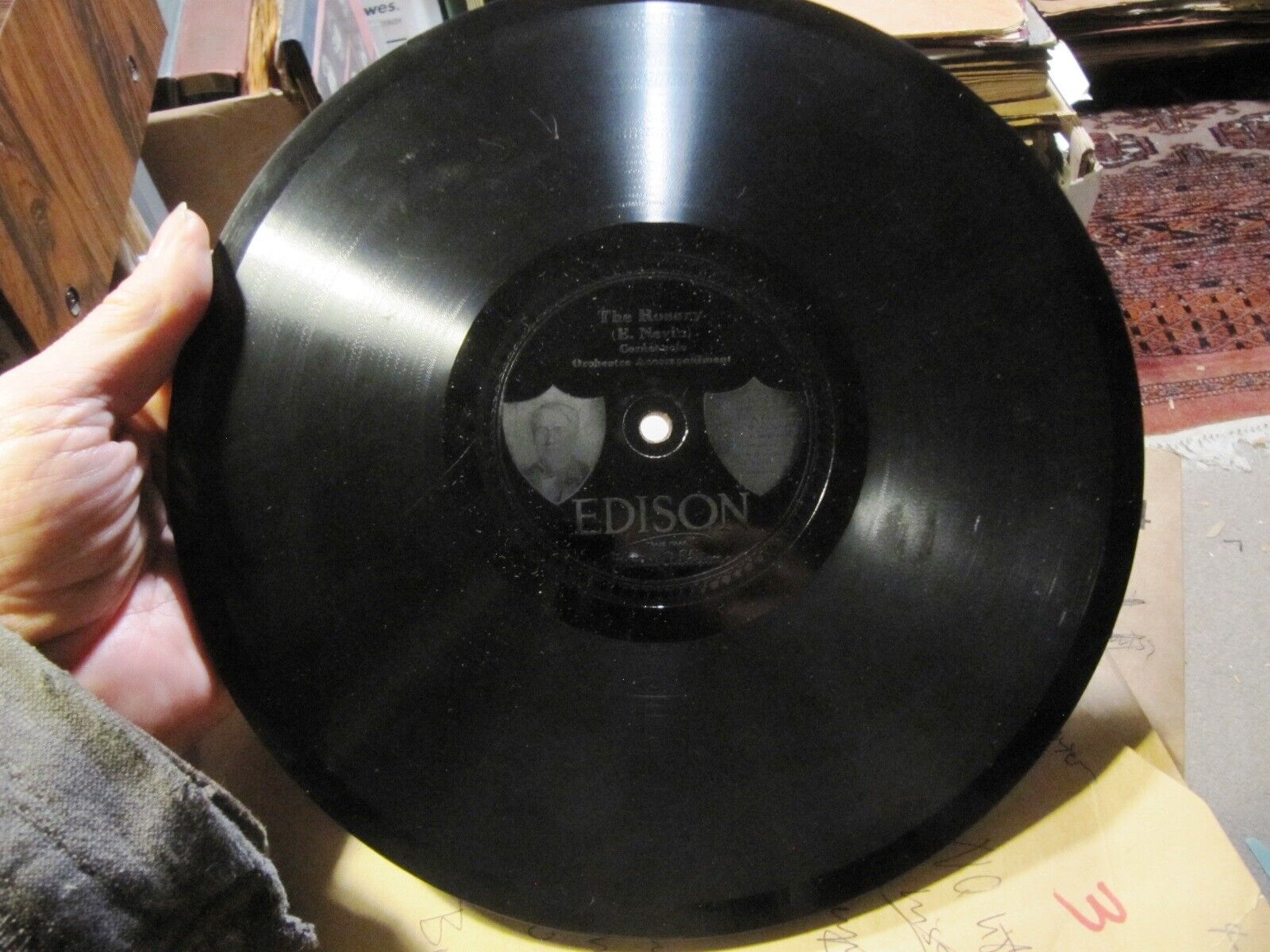
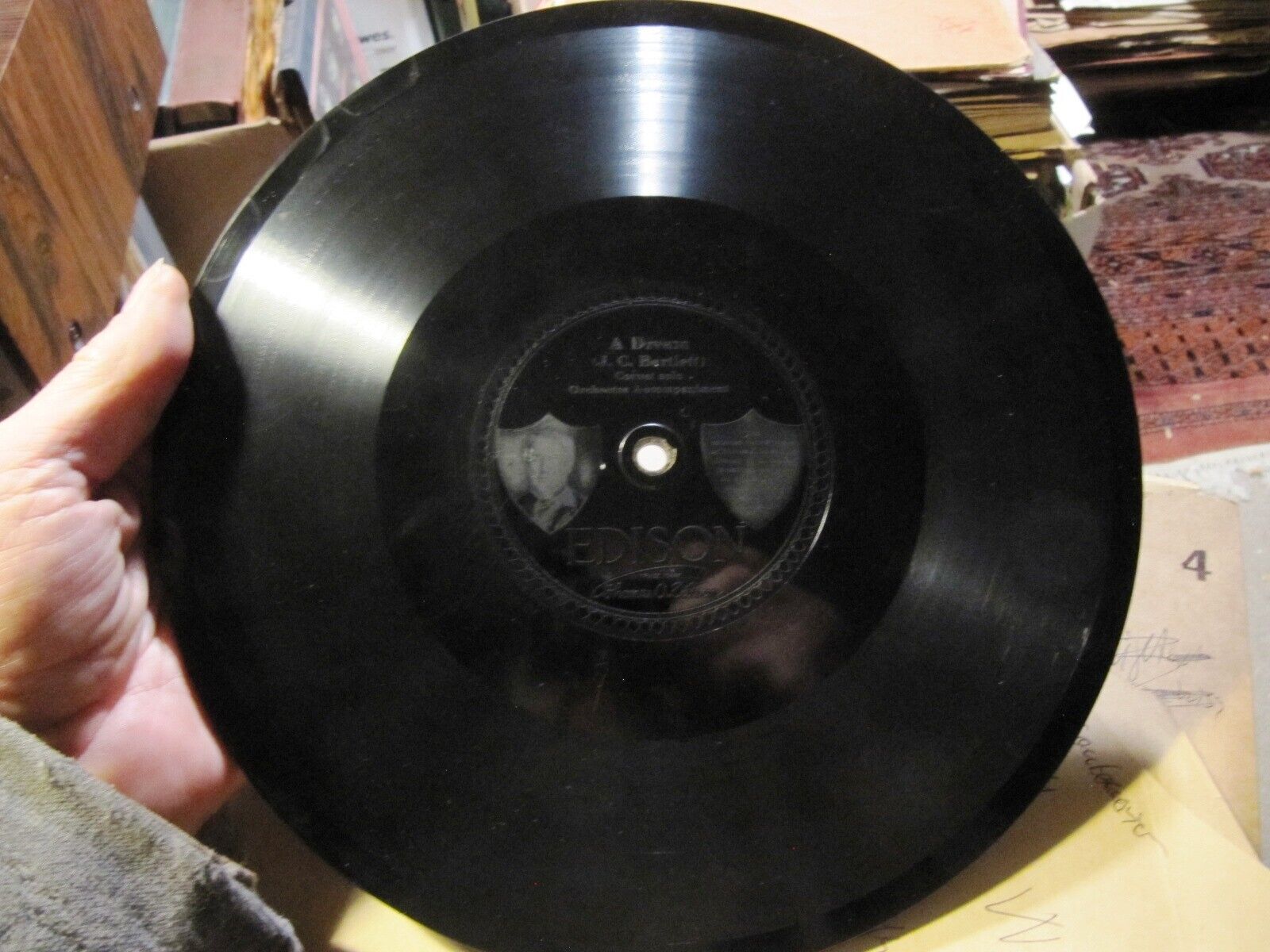
1914 Cornet Solo ERNST ALBERT COUTURIER LAMINATED EDISON Diamond Disc 50174
$
25


$ 25
Sold For
May 5, 2024
Sold Date
Apr 14, 2024
Start Date
1
Number Of Bids
USA
Country Of Seller
eBay
Sold at
Favourite Auctions
To save auctions to your favourites, please login
If you don't have an account, please register
Description
A series of great Edison Diamond Discs, Pathe, Rex, Lyric, Operaphone and other Vertical format records
Click this link for more great Edison, Pathe and Vertical Records in my other listings!
Great example of an early Laminated Edision Diamond Disc produced only in 1913 and early 1914. After that, Edison produced the noisy "Etched Label" records. Early Edison records have no performer credits on the label.
These are prized for there superbly quiet surfaces, however they often suffer from lamination cracks and in the worst case curling of the surface.
Hallmarks of a laminated record is the (usually) stippled matte faceplate, the large black ring around the spindle hole.
Laminated Diamond Discs are usually slightly larger in diameter and thicker
E.A. Couturier
Great Cornet Solo by Ernst Albert Couturier with chamber ensemble acc.
Rec Numb 50174-R 50174-L Take A B Title The rosary (Ethelbert W. Nevin / Robert C. Rogers) A dream (James C. Bartlett / Charles B. Cory) Artist Ernst Albert Couturier (ct), (O) Ernst Albert Couturier (ct), (O) Recorded 1914.05. 1914.05. Place NYC NYC Comment acoustic acoustic
Orig LAMINATED Issue without Performer Credit Edison Vertical Diamond Disc 10" 78 rpm.
CONDITION: EXCELLENT close to PRISTINE light scuffs, small lam and tiny on blank rim do not sound on L Side, faint 4 mm scratch on R Side does not sound, faint matte spot on R side does not sound, Plays EXCEPTIONALLY QUIET rare ticks
A CHOICE COPY
Ernst Albert Couturier (September 30, 1869 in Poughkeepsie – February 28, 1950 in Wingdale) was best known as a cornet player who toured as a "virtuoso" performer on the concert programs of bands of the day. He promoted the Holton Band Instrument Company for a decade in that capacity before applying his own unique inventions to the production of his own line of brass band instruments between 1918 and 1923.
Life
E.A. Couturier was born September 30, 1869, in Poughkeepsie, New York to a family with three other children.[1] At the age of fourteen, he began playing the cornet.[2] He entered the New England Conservatory of Music in 1885, but withdrew and took a job repairing watches in his uncle's shop.[1] He began playing professionally in various bands in the 1880s and in 1890 began composing for band. In 1892, he became director of his first band and, in 1907, took a job at Frank Holton Company as a promoter of their instruments.[1] He received his first patent (U.S. patent 1,073,593) on September 23, 1913, for a more conical bore cornet. In 1916 he opened his own manufacturing concern with two other partners to produce brass band instruments.[2] That firm failed after Couturier lost his eyesight in 1923, was bought by Lyon and Healy, and ceased operations in 1929. Couturier suffered a mental breakdown and died on February 28, 1950, in the Harlem Valley Psychiatric Center in Wingdale, New York.[2]
Solo career
Couturier began as a piano and violin student, choosing cornet in 1883. By 1885, he was playing well enough to be accepted to the New England Conservatory.[1] He was a student of Theodor Hoch, a proponent of placing all pressure on the lower lip, for four years.[2][3] In the 1880s he began playing professionally in bands such as the Twenty-first Regiment Band, the Eastman Business College Band, Innes Band, and the Gilmore band.[2] At age 17,[1] he was able to play Herbert L. Clarke's Variations on Carnival of Venice, which is noted as a virtuoso piece with seemingly insurmountable technical difficulties, and developed a six octave range.[3] In 1902, he made his first tour as a feature act soloist playing a Conn Wonder[1] cornet across several Midwestern states. In 1906, he toured Europe where he also demonstrated multiphonics,[1] the production of more than one note at the same time on an airophone, which according to The American History and Encyclopedia of Music is not possible on cornet.[4] The Frank Holton Company then hired Couturier to perform on, consult in the development of, and promote Holton cornets. The Holton New Model cornet was sold under the name "Couturier New Model" in the 1910s. Business matters were distracted from Couturier's playing for several years. Still, after the loss of his own company in 1923, he began playing again in Los Angeles until 1929 when he returned to Mt. Vernon New York.[1][2]
Composer and Conductor
Couturier did not devote much of his career to composition, but did author several works. Among these are The Maine's Avenger March, The First Commander March, and The Van der Veer Two Step. In 1882, he directed a band of his own, and he also stepped in as director of the Gilmore Band in 1898.[2]
price rating