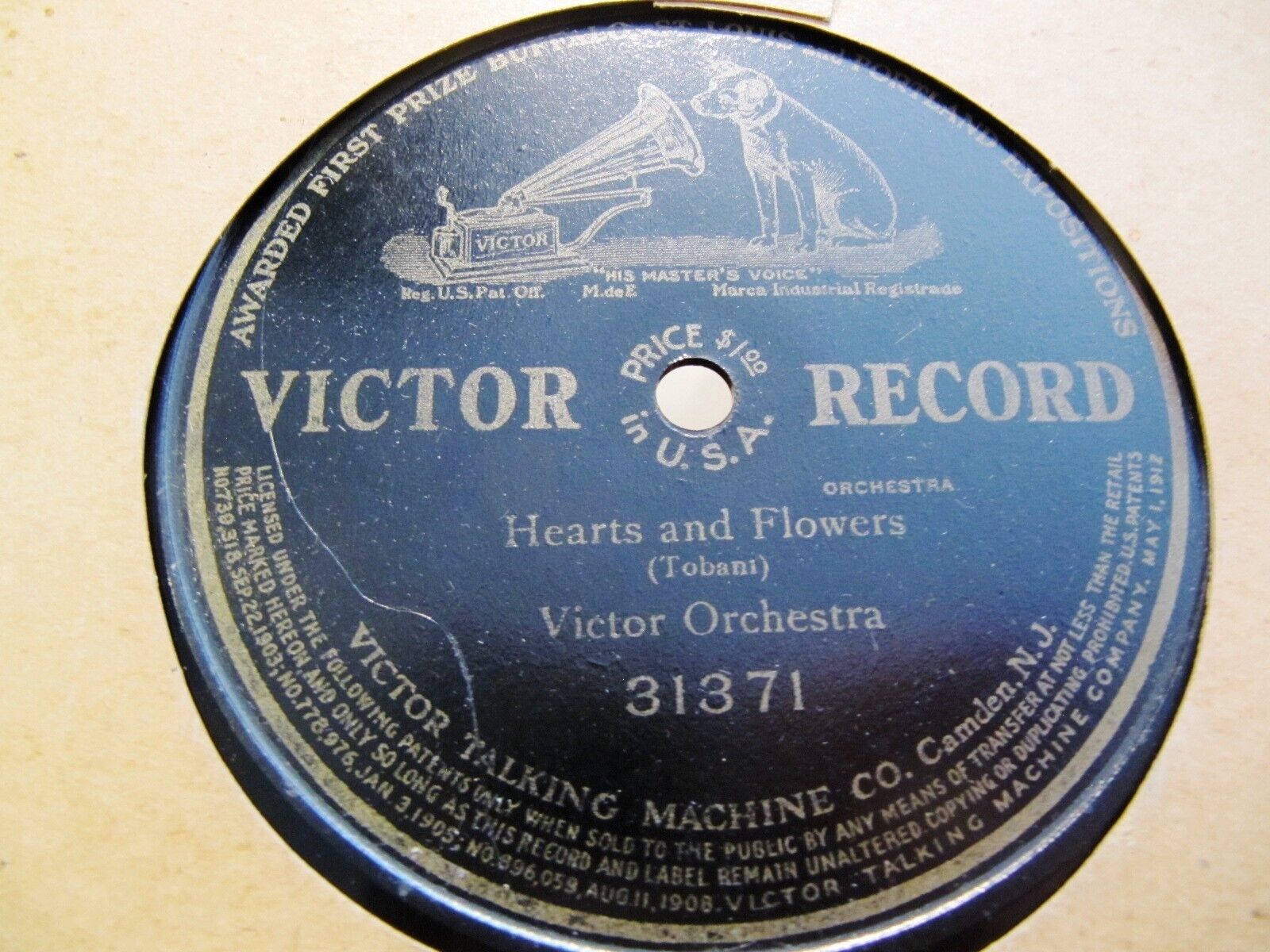
1908 SILENT MOVIE Hearts and Flowers Tobani Josef Pasternack VICTOR 31371
$
25


Favourite Auctions
To save auctions to your favourites, please login
If you don't have an account, please register
Description
A series of great Orchestra Records by great conductors on 78 rpm records
Click on this link to see more great Conductors and Orchestral Records!
Josef Pasternack conducts the Victor Orch with the famous Silent Movie characteristic Piece
A great violin solo (probably Howard Rattay) in the melancholic piece which became famous as Silent Movie Mood Music: Hearts and Flowers
Arthur Pryor would record a 10" version in October 1908
Second published TAKE 3
Hearts and flowers Intermezzo
Theodore Moses Tobani (composer)
Victor Orchestra (Musical group)
Josef Pasternack (conductor)
6/18/1908 Camden, New Jersey [unconfirmed] 3 Master Victor 31371 12-in.
Please see top of the page for condition
Hearts and Flowers" has an association in popular culture as melodramatic photoplay music. The practice of using the selection as a dramatic cue is documented as early as 1911,[1] although complaints that the tune was becoming overplayed crop up as early as 1913 [2] and 1914,[3] and by 1915, the piece was being called "time worn".[
Hearts and Flowers" (subtitle: "A New Flower Song") is a song composed by Theodore Moses-Tobani (with words by Mary D. Brine) and published in 1893 by Carl Fischer Music.
The famous melody is taken from the introductory 2/4 section of "Wintermärchen" Waltzes Op. 366 (1891) by the Hungarian composer Alphons Czibulka. Tobani arranged the piece in a 4/4 song form as Hearts and Flowers, a New Flower Song, Op. 245. The song as a vocal number was soon forgotten but the instrumental version gained popularity in its own right and it is in this form that it remains well known to this day. Tobani also arranged the tune as a waltz, featured in a medley published in 1900 entitled Beauties Charms, although this arrangement is now seldom heard.
"Hearts and Flowers" has an association in popular culture as melodramatic photoplay music. The practice of using the selection as a dramatic cue is documented as early as 1911,[1] although complaints that the tune was becoming overplayed crop up as early as 1913 [2] and 1914,[3] and by 1915, the piece was being called "time worn".[4]
Soon thereafter, "Hearts and Flowers" (along with Gustav Lange's "Flower Song") became more commonly associated with underscoring an over-the-top parody of melodrama in film. Around 1919, musical accompaniment cue sheets start suggesting the tune "a la burlesque" to mock-dramatic scenes.[5] Even into the late 1920s, "Hearts and Flowers" continued to be suggested as a burlesque dramatic piece.[6]
"Hearts and Flowers" was not only heard in theater as accompaniment to films, but played an integral part of on-set music for actors. Viola Dana famously requested the tune to be played in order for her to generate enough emotion for her to cry real tears.[7] This was later parodied in the 1928 film Show People with Marion Davies.
The song eventually became a byword for maudlin love songs. It was used in the title of a chart hit for singer Johnny Desmond in 1954, "Play Me Hearts and Flowers (I Want to Cry)".
The term 'hearts-and-flowers' has entered the English language with the sense "extreme sentimentality, cloying sweetness".[8]
The 1958 Jack Kirby comic story "Hearts and Flowers" makes direct reference to the song as outdated but still moving, prompting the hip, street-wise narrator to use the song as shorthand for his own romantic nature: "The music that came out was square as a frame. But it washed against me like the waters of a dark ocean..."[9]
There is a reference to "Hearts and Flowers" in Amazing Spider-Man #45, published February, 1967.[10]
It is also the song used during the scene 'Toast', in Noël Coward's play, 'Family Album', where his character calls it "The loveliest song in the world", after his wife has sung Mary D. Brine's lyrics to it at the dinner table.
Little Wonder Records was a United States record label from 1914 through 1923.
Little Wonders were manufactured by the Columbia Phonograph Company, and were distributed exclusively by Henry Waterson (the business partner of Irving Berlin) in their early years (1914-1916) -- an arrangement that has only recently been discovered as the original contract stipulated that both parties were to keep this relationship a secret. Artists are generally uncredited on Little Wonder labels, which simply give recordings such general attributions as "band", "tenor", "quartette", or "accordion solo".
Little Wonders were lateral-cut single sided 5½ inch gramophone records. The records contained only about 1½ to 2 minutes of music. The small size of the discs (together with the cherubic face on later versions of the label) has led some record collectors to incorrectly assume that Little Wonders were made as children's records; they were actually made for the general audience looking for low-priced recordings.
The records retailed for ten cents each, some of the lowest priced recordings available at the time. This price point revolutionized popular recorded music, making it possible for everyday people to purchase and listen to music other than live performances. The audio fidelity is average to slightly above average for the time, with rather narrow grooves (best played with a smaller stylus than contemporary discs). Millions and millions of these records were sold, principally through many 5 & 10 cent department store chains of the time and through Sears & Roebuck catalogs.
There is some controversy about whether Little Wonders were made by artists who recorded for Columbia. One account says that recording artists would visit the Little Wonder recording studio on one floor of the Woolworth Building before or after making records at the Columbia studio on a higher floor of the same building. And there has been some speculation that the masters for Little Wonders were actually warm-up balance checks recorded as tests at the beginning of Columbia recording sessions; if such tests happened to record a usable performance, they would be leased to Little Wonder. However, court papers from an early lawsuit between Waterson and Victor Emerson indicate that performers were paid separately and specifically to record for Little Wonder records.
Among the noted artists of the day whose performances were released (uncredited) on Little Wonder include Al Jolson, Gene Greene, Wilbur Sweatman, Billy Murray, Vernon Dalhart and the Louisiana Five.
Little Wonder # 339, "The Camp Meeting Jubilee" by a male vocal "quartette", issued in 1916, contains the lyrics "We've been rockin' an' rolling in your arms / Rockin' and rolling in your arms / In the arms of Moses." This is believed to be the first use in an audio recording of the phrase "rock.. and roll..", albeit in the context of a religious spiritual rather than its later secular use.
price rating