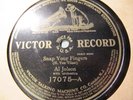
1902 WARSAW G&T MATTIA BATTISTINI Bar Barbiere LARGO AL FACTOTUM MONARCH 91055
$
75


Favourite Auctions
To save auctions to your favourites, please login
If you don't have an account, please register
Description
A series of great OPERA Records from early G&Ts to World War II recordings on 78 rpm Victrola Records
Click this link for more great Opera and Vocal Records in my other listings!
Battistini in the 1910s
The greatest of all baritones: Mattia Battistini,
in one of his first G&T session 1902 WARSAW recordings
MATTIA BATTISTINI w Piano Barbieri di Sivigla Largo al Factotum
Matrix 447c
- a feat in speed singing, Battestini puts a 5 min aria into 3:28 mins. The stretta becomes a flow of words.
Read below for a detailed analysis
Please see top of the page for condition
The great Italian baritone Mattia Battistini (1856-1928), dubbed the "King of the baritones" and undisputably one of the giants from the "Golden Age of Opera", in Figaro's aria 'Largo al factotum' from Act 1 of Rossini's Il Barbiere di Siviglia. The recording was made in 1902 for the Gramophone & Typewriter Company. In his biography "Mattia Battistini: King of Baritones and Baritone of Kings", Jacques Chuilon has this to say about this particular recording (145-146): "...in "Largo al factotum" from Rossini's Barbiere, a warhorse for all baritones of the day, the ascent to the high G on "Là, là, là,là!" has become such common practice that no one would doubt its authenticity. We even regard it as a criterion for a great performance, and since Battistini does not do it, his reading is automatically deemed inferior. Another excellent opportunity to denounce the excessive liberties of golden-age singers! Unfortunately, Battistini sings the passage as written (though it is seldom doneso). One might be taken aback by the ad libitum on "Tutti mi chiedono, tutti mi vogliono," though it would be hard to find greater fault with that indulgence than with others' more hackneyed touches. In other words, to criticize Battistini's liberties in this aria would wrongly imply that all the other variants to which we have become accustomed are obligatory. Comparisons with the score reveal that Battistini avoids the higher variants here, even though he tends not to shy away from them in other pieces, to an extent that makes one wonder: did a concern for preserving tradition steer Battistini toward the variants of the earliest famous interpreters of the role, who were usually bass-baritones? Yet his version sounds much more roguish than the current norm, because the singers who succeeded him and with whom we are most familiar generally have a darker voice, even a "villainous"-sounding timbre. Who is closer to the spirit of the original? The coda's acceleration is dizzying, but not performed exactly according to today's procedure: Battistini glosses over the words, which gradually melt into a liquid flow. No doubt it is the effect intended by this kind of writing, in which meaning dissolves amid the repetitive, musical sound, becoming comic. The high G is brilliant, resonant, and unforced."
Italian baritone, 1856 - 1928
ôLa Gloria dÆItalia - Il Re dei Baritoniö
Biographical notes:
He was born in Rome and brought up in Contigliano, a village near Rome. His father, a professor of anatomy at Rome University, would have preferred his son to take up a career in medicine or law, but from the beginning Mattia showed a prodigous musical talent. He studied with Venceslao Persichini (who also taught Francesco Marconi, Titta Ruffo and Giuseppe de Luca). While still a student he sang in public. His debut was in DonizettiÆs La Favorita in 1878 which was an immediate success. In the first three years he toured Italy and appeared in roles of La Forza del Destino, Il Trovatore, Rigoletto, Il Guarany, Gli Ugenotti, Dinorah, LÆAfricaine, I Puritani, Lucia di Lammermoor, Aida, Ernani, as well as taking part in the world premieres of several ônewö operas. What a repertory for a young singer! He went to South America in 1881 for the first time, where he travelled for more than one year. By his returning, he appeared in Barcelona and Madrid where he sang in RossiniÆs Il Barbiere di Siviglia. His success in this role was enormous. In 1883 he came to Covent Garden where he appeared opposite Marcella Sembrich, Francesco Marconi, Edouard de Reszke and Adelina Patti. In 1888 he travelled to South America again. It proved to be his last trans-Atlantic trip. He never appeared at the Met or any other American opera house. He was said to develop a horror of the Atlantic-crossing. He more and more orientated his career to Imperial Russia. He used to travel to Warszaw, St. Petersburg and Moscow like a prince, with 30 trunks, each one embossed with the initials, æM.B.Æ, and each one containing a wardrobe of different stage costumes! Warszaw (then in Imperial Russia) was the place where the famous Italian vocalists gathered at the turn of the century. BattistiniÆs first recordings (1902) were made there. Battistini was a close friend to the TsarÆs family. He was the most acclaimed singer of his time by the Russian aristocracy. He returned to Russia regularly for 23 seasons! Other cities he appeared in were Paris, Lisbon, Barcelona, Madrid, Milano, Berlin, Vienna, Prague and Budapest. After Worldwar I he toured with his own company. His career lasted almost 50 years! He gave his last concert performance one year before his death, his voice was still in very fine condition.
Comment:
Mattia Battistini is generally considered to be one of the great figures in 20th century vocal history. His recordings are unique examples of a vanished vocal culture. He marks the end of a vocal epoch that reaches far back into the 19th century. None of the singers to follow had this kind of elegance and finish of style.
It may come as a surprise to hear a voice that seems far more comfortable in the tenor than in the baritone range. His upper middle register was of extraordinary beauty, the low register astonishingly weak. In the tradition of the 19th century there existed the vocal category of a ôBaritenore.ö Some roles (e.g. RossiniÆs Otello) were especially written for this type of voice. If one listens to BattistiniÆs recordings from the point of view of historical development, one will immediately acknowledge his singularity. He is a true singerÆs singer.
ôThe pure, silk quality of his tone in a delicate cantilena was a joy, yet he lacked neither vigorous energy nor the vibrant power and depth of expression color that go to the make-up of a convincing dramatic singer. The flexibility of his organ and his rare vocal agility made him a complete master of the Rossinian roulades and fiorituri. He was more than a most excellent actor...ö
The renowned music critic Herman Klein on BattistiniÆs Figaro
ôMy school is in my records.ö
...Elegance and finish of style, coupled with a consummate mastery of phrasing and expression. That is Battistini...
price rating